Friday, October 22, 2010

Lyndon Johnson's 1964 World's Fair Prophesies

For those of us of a certain age, it seems difficult to believe that it has been nearly fifty years since the last world's fair took place here in New York City. It was 46 years ago, to be exact, that President Lyndon Johnson arrived in Flushing, Queens to deliver a speech on the fair's opening day, April 22, 1964. It had been six months--to the day--since Johnson had been thrust into the presidency upon the assassination of President Kennedy. The country was still in mourning, and the early days of the Johnson administration had largely been devoted to restoring confidence and some optimism to a people still grieving and still in shock.

A time would come, in the not too distant future, when Johnson would not be able to appear in New York City without thousands of anti-war protesters greeting him with the chilling chant, "Hey, hey, LBJ! How many kids did you kill today?", but that still lay ahead. It was a sad honeymoon period in the Johnson presidency, but compared to what would come later, a honeymoon it was. Still ahead, too, was the 1964 election in which the prospect of a President Barry Goldwater would so frighten the American people that Johnson would finally take office in his own right with one of the greatest landslides in the history of American presidential elections. And thus, the time was ideal, on a blustery spring morning on the plains of Flushing Meadow Park, for Johnson to make an inspirational speech.

I watched the speech earlier in the evening on City Classics, a television show that goes into the city's archives and takes a look at its past history, and I was struck as much by what Johnson got right in his stab at prophecy as what he got wrong. It was natural for Johnson, a product of New Deal liberalism and an admirer of Franklin Roosevelt, to turn with some pride to what the nation had achieved since the previous World's Fair held in New York City in 1939, a year in which the U.S. was still suffering through the Depression but beginning to look ahead to better times:

The last time New York had a World's fair, we also tried to predict the future. A daring exhibit proclaimed that in the 1960's it would really be possible to cross the country in less than 24 hours, flying as high as 10,000 feet; that an astounding 38 million cars would cross our highways. There was no mention of outer space, or atomic power, or wonder drugs that could destroy disease.


These were bold prophecies back there in 1939. But, again, the reality has far outstripped the vision.

Now it was Johnson's turn at the role of prophet, and, as he peered into the future, he said:

I prophesy peace is not only possible in our generation, I predict that it is coming much earlier. If I am right, then at the next world's fair, people will see an America as different from today as we are different from 1939.

They will see an America in which no man must be poor.


They will see an America in which no man is handicapped by the color of his skin or the nature of his belief--and no man will be discriminated against because of the church he attends or the country of his ancestors.


They will see an America which is solving the growing problems of crowded cities, inadequate education, deteriorating national resources and decreasing national beauty.


They will see an America concerned with the quality of American life--unwilling to accept public deprivation in the midst of private satisfaction--concerned not only that people have more, but that people shall have the best.

Although no new world's fair is currently scheduled to take place here in New York, now, half a century later, we can take stock of just how well President Johnson did in his role as a prophet. The reader may share with me a certain chill at the accuracy of his first sentence: "I prophesy peace is not only possible in our generation, I predict that it is coming much earlier." Johnson, of course, had no way of being able to foresee wars in Iraq or Afghanistan, and even if he had the ability to do so, would have considered such adventures far less significant than the over-riding concern for his generation of post World War II politicans, the Cold War with the Soviet Union. It would be exactly 50 years after the 1939 World's Fair took place that the Berlin Wall would come down, soon taking with it the entire structure of Soviet communism, and hopefully the threat of a global nuclear holocaust. Whether a product of optimism or genuine political insight, in this first prediction, Johnson amazingly got it right.

In just the brief moment in which we have to celebrate this bit of political perspicacity, however, a far different mood begins to emerge upon his uttering the very next sentence: "If I am right, then at the next world's fair, people will see an America as different from today as we are different from 1939." Listening to the speech in 1964, an audience might well have concluded, (as many did after the fall of the Soviet Union), that the differences one would see in such an America would all be positive, that there would be enormous post cold war "peace dividends." Instead, in the light of what has actually taken place since 1989, Johnson's next predictions have a truly tragic resonance.

"They will see an America in which no man must be poor."

The president who would come to initiate the "War on Poverty" during his tenure almost fifty years ago might be surprised to find that, according to the Census Bureau, one in five American children live in poverty, precisely the same number that existed while he was in office, and that, in 2009, the number of Americans living in poverty rose to an estimated 43.6 million.

"They will see an America in which no man is handicapped by the color of his skin..."

The president who, just four months after this speech would sign the 1964 Civil Rights Act into law and, a year later, sign the Voting Rights Act, might well take pride in the truly revolutionary changes that have taken place in the lives of Black Americans. That a Black man would be elected president in 2008 might both surprise and be a source of intense pride. Nevertheless, a nation in which "no man is handicapped by the color of his skin" remains an as yet unrealized (and, according to some pessimists, a systemically impossible) goal. Furthermore, the deep divisions that the '64 and '65 civil rights legislation engendered continue to play havoc not merely with the prospects for racial harmony and integration, (the Kerner Commission's own prophesy of "two societies, one white and one black--separate and unequal" having been largely realized), but have evolved into a "red states, blue states" dichotomy that, while there is a constant undercurrent of race, has taken on the characteristics of a far broader and deeper, almost theological schism.

"...or the nature of his belief--and no man will be discriminated against because of the church he attends or the country of his ancestors."

On this score, Johnson can certainly be forgiven his lack of foresight since it would be hard to find even a single American who, in 1964, could have foreseen the era of Islamophobia, "Islamofascists" and the mere possibility of a debate about locating a Muslim house of worship on a particular piece of real estate. It would probably be indelicate even to speculate on the images that the word "Muslim" conjured up in the citizenry of 1964. "Gobalization" as we now know it was more the stuff of science fiction novels than a real prospect for the near future.

"They will see an America which is solving the growing problems of crowded cities, inadequate education, deteriorating national resources and decreasing national beauty."

Here, too, the pace of progress has been disappointing--to put it mildly. For a while it seemed that our nation was going in the direction not of crowded but of depopulated cities, depopulated by the aftermath of "burn, baby, burn," white flight to the suburbs, a spreading rust belt and red-lining by the worlds of banking and finance. One may no longer see the word "ghetto" in print, its having been replaced by the euphemistic "inner-city" jargon, but the ghettos are still there. Little progress has been made in education reform, and black children in Northern ghettos are now more segregated than their brothers and sisters in the schools of the former Confederacy. In spite of the greatest accumulation of wealth in human history, the multi-billionaires of our own era seem not to have the propensity for building libraries and museums that the so-called "robber barons" of the past bestowed upon urban centers in the past, most American cities now having been abandoned for all-white enclaves and gated communities on what was not so long ago farm land. The preoccupation of President Johnson's wife, "Lady Bird" Johnson, with highway beautification now seems quaint, her desire to "leave this splendor for our grandchildren" a piquant historical artifact in an era of profound decay of infrastructure.

"They will see an America concerned with the quality of American life--unwilling to accept public deprivation in the midst of private satisfaction--concerned not only that people have more, but that people shall have the best." (Bold mine.)

It is here, in President Johnson's final prophesy, that we find the key, the very essence of why so much that his speech looks forward to has failed to be realized. While his speech must be credited with having alluded to this core understanding of how a "great society" is maintained and developed, tragically, the nation has proven itself all too willing "to accept public deprivation in the midst of private satisfaction." It is our willingness to accept public deprivation that explains the absence of public transportation, health, housing and education standards that the rest of what we proudly call the "civilized world" takes for granted. The New Deal liberalism that produced Lyndon Johnson's public philosophy has now been subsumed under the rhetoric of creeping socialism and dread Europeanization. The prevailing philosophy of the post-modern United States, antithetical to the naive utopianism of both old world philosophies and the hopeful optimism that prevailed at both the 1939 and 1964 world's fairs has resulted in a land resembling Brecht's Mahogonny, a land dominated by what another European writer, the Englishman Thomas Carlyle, in 1839 described as "the cash nexus." "You get what you pay for," Mr. and Mrs. America. No state subsidized bullet trains for us, no national health insurance, no adequately funded public schools. A nation not merely of two races--separate and unequal, but of two classes--separate and unequal: the very, very rich and the rest of us.

Tuesday, September 21, 2010

Republican Rule: Not 30 Years, But 40

On the liberal side, in the aftermath of the Great Recession, we are now accustomed to sentences beginning with the phrase, "After thirty years of Republican rule...". I have done it myself. Many times. And it is convenient enough to see in the Reagan administration the beginning of our descent into a society bereft of reforms inaugurated with the period of the New Deal. The reality is that the political pendulum began to swing to the right with the election of Richard Nixon in 1968 and has never really changed direction in the ensuing years--in spite of the election of two Democratic presidents. In so many ways, 1968 more than earned its designation as "the year the world ended."


By the end of the Johnson administration, the cultural aftermath of the Kennedy assassination, the war in Vietnam and what we euphemistically call the Civil Rights movement had so thrown the American landscape into near anarchy that even Walter Lippman, the revered liberal lion of journalism, was calling for a Nixon victory and the restoration of "law and order." Racial polarization transformed Southern Dixiecrats into Southern Republicans who would gradually gain more and more power. In the North, the white working class increasingly distanced itself from the Democratic Party until their ultimate transformation into Reagan Democrats, and they have never gone back.

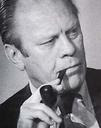
Nixon's counter-revolution, though mild when compared to what would be initiated during the Reagan era, was nevertheless odious enough, in combination with his overt and covert conduct of the war in Vietnam, to make him the victim of an expiatory exercise that is subsumed under the label of Watergate. After Nixon was forced out of the White House, Gerald Ford, Nixon's Vice-President, became president and Nelson Rockefeller was placed a heartbeat from the oval office. Ford was essentially a caretaker president. A trusted apparatchik of the nation's permanent government who had served on the Warren Commission investigating the murder of President Kennedy, Ford, who probably knew as many of our state secrets as any man alive, was portrayed in the media as a pipe-smoking, comfortable figure who provided comic relief by stumbling off airplanes. Just folks. Non-threatening. The tarnish of the Nixon administration never quite wore off Ford though, particularly when he pardoned his erstwhile superior early on in his administration. That decision no doubt played a role in opening the door to a switch to the Democratic Party in the figure of a truly unique American politician, a part-time peanut farmer from Georgia, a president the country felt comfortable calling "Jimmy."

James Earl Carter, Jr. was not your typical peanut farmer, however. Governor of his state, a naval officer, a nuclear physicist and a Southern Baptist minister, during his candidacy he had his hair coiffed into a Kennedy-esque forelock that he often brushed aside with one finger, campaigned on a platform of what amounted to moral rearmament, and defeated Nixon's successor, Gerald Ford. His was not a happy time in office, however. Carter's tendency to Protestant preachiness did not help an administration plagued by high interest rates, Americans taken hostage in Iran, an energy crisis that saw long lines of drivers waiting to fill their gas tanks, and his own televised pleas to have us all turn off our lights and electrical appliances. Depressing. We will look more closely at the man and his presidency later, a man whose beatification now rests on his association with Habitat for Humanity, his criticism of Israeli imposed apartheid in the occupied Palestinian lands and an alleged penchant for refreshing candor.

Americans like full gas tanks and well-lit homes. And thus the unthinkable occurred. In the presidential election of 1980, Ronald Reagan defeated Carter in his run for a second term and became president of the United States. It is with Reagan's taking office that most current accounts date the beginning of the true counter-revolution, the gradual, seemingly inexorable destruction, one by one, of the gains made by working class Americans through the greater part of the twentieth century. Exorcise those images of UAW workers battling police and being shot down, of kids in the CCC, artists in the WPA, bank regulations, the struggle for social security. Regulations were torn up, often by the very individuals appointed to the various commissions to execute those regulations. The demise of the union movement that began with Reagan's firing striking air-traffic controllers continues its downward slide to this day. White Protestant Southerners and White Catholic Northerners made an unholy alliance motivated largely by racial fears (when not actual racial hatred) and decided to barter their hard-won gains for a tacit agreement that their prerogatives, nebulous and ill-defined as they have been and still are, would not be traded away. By 1968, in another expiatory exercise, a commission was formed to look into the causes of the race riots that had destroyed literally thousands of American cities. Famously, (though currently seemingly forgotten), the Report of the National Advisory Commission on Civil Disorders, or Kerner Report, found that:

"Our nation is moving toward two societies, one black, one white—-separate and unequal."


In the almost unbelievably short twelve-year period since the report had been issued, the transformation into two societies was realized. Once thriving American cities like Newark, New Jersey, cities that were by European standards just babies that had only begun to grow in the 1920s, were now, a mere forty years later, abandoned wholesale by their former white citizens. White flight transformed the American landscape into two sectors--white suburbs with their sprawling tract housing, malls and parking lots, and abandoned "inner cities" inhabited by black and brown citizens living beyond the protective moats of remnant silk-stocking enclaves. The phenomenon was not restricted to the nation's smaller cities. Detroit was left in ruins, and, for a while, in the 1970s, it seemed even New York, the vaunted capital of world finance (and some would say, the world) looked as if it would crumble into decay.


In spite of being a mean-spirited, Byzantinely complex man who seemed to have equal distaste for redwood trees, college students, unions and commies, Ronald Reagan truly earned his title of "great communicator" and the resultant sainthood bestowed upon him by American conservatives. Schooled as a film actor in "B" movies, he went on to host a television show in which he served as spokesman and lobbyist for General Electric ("Progress is our most important product."). To a national constituency thirsting, hungering, for reassurance that the life style that had prevailed concurrent with his reign as television host in the 1950s (the golden age of the American Dream) could somehow be restored, his message was loud and clear. Stick with me and I will dispatch the commies, the students, the urban rioters, the unions and all that socialist legislation that gave us the time of troubles we have endured. It may cost you a little, but I will make it worth your while.


As it turned out, fate and the inexorable wheels of economic change were on Reagan's side. For many, it was never really about race--it was about the class struggle. That class struggle obviously had its manifestations outside of the United States as well. The world economy had evolved to a juncture that saw the rise of Margaret Thatcher and Mikhail Gorbachev across the Atlantic, in their realms just as pressed as Reagan was here to save their kingdoms via counter-insurgencies. By the time Thatcher had torn up the social contract in Great Britain and perestroika and glasnost had run their course in the USSR, Ronald Reagan, conveniently addled by Alzheimer's during inquiries into his role in the blatantly unconstitutional Iran-Contra capers, could comfortably witness the handing over of power to his Vice-President, George Bush.

No one was truly prepared for the demise of the Soviet Union, least of all, it seems, the one-time CIA operative who occupied the Oval Office during those historic events. (With the possible exception of one writer for a show called Rowan & Martin's Laugh-In whose running skit called "News of the Future" announced in 1969 that the Soviet Union would collapse in twenty years, thereby not only calling the event, but the exact year, 1989.) Like his former boss, George Bush should have been impeached for his participation in Iran-Contra, but even with the passing of over a decade, the country was wary of being subjected to another period of self-flagellation and so allowed Bill Casey to take a (metaphoric?) cyanide capsule and Oliver North to don his Marine uniform and manhandle the U.S. congress during the Iran-Contra hearings to make the whole debacle disappear. So adamant were the American voters to see the emperor's clothing that they elected the rather peculiar Bush president. At the first opportunity, however, (and he offered it up on a silver platter by reneging on his "read my lips" promise not to raise taxes), they turned him out of office rather than tolerate him for a second term.

So anxious were the voters to put Bush behind them that they nominated and elected an Arkansas governor and striver named William Jefferson Clinton, popularly known, in the Southern fashion, as just plain Bill. So anxious were they to put Bush behind them that the voters turned a blind eye to leading indicators of his character such as the revelation of an affair with a woman named Jennifer Flowers and a laughable response to a query about his use of marijuana that had him smoking the weed, but not inhaling. (Later to gain entry to Bartlett's with the truly memorable, "It depends on what the meaning of the word is is.") A Yale graduate and Rhodes scholar who had evaded the draft during the war in Vietnam and thus the first president in a long time who had never been in uniform, Bill's idol was John F. Kennedy--for reasons that would only later become obvious. Just as fortune protects the working girl and presidents like Ronald Reagan, Bill Clinton was the recipient of another turn of fate that, (after a slightly rocky start in which he proposed that gays be allowed to openly serve in the military, his first lady's ill-starred run at inaugurating national health insurance and an inconveniently timed recession), saw one of the greatest "bubbles" in our financial history. Although the standard of living of most Americans was still in decline, the eight years of the Clinton presidency are viewed as a period of great prosperity. The man who would be labeled "the first Black president," and, at the same time seemed to have deftly co-opted enough of the Republican programme to survive the likes of Newt Gingrich and his "Contract with America," might have gone on to take action on what he described as the three leading issues in American life, namely, race, education and the restoration of American railways, a formidable trio. (He had apparently been scared off the health care issue.) Unfortunately, a White House intern ended the Clinton version of Camelot. The Monica Lewinsky scandal illustrated the fact that enough time had passed since Watergate for the previously unthinkable descent into another impeachment episode. (Strictly speaking, there was overwhelming evidence that presidents Reagan and Bush should have been impeached earlier and a wide consensus that Bush's son should also have been a candidate for that fate. Add Nixon and Clinton who actually were impeached, add Johnson's being forced out, and we have quite a run of presidents since 1963.) Then, too, Republicans relished the idea of showing that Democrats could also be impeached.

Republicans reserved for Clinton a kind of hatred that can only emerge between close relatives. They hated the man, hated him with a transcendency that overcame any overarching, grinding wheels of economics and history. In the end, young readers of the New York Times were treated to transcripts that spelled out in almost unspeakably lurid terms what the meaning of "is" was. Rather than spare the nation so humiliating and endless a preoccupation with his sexual infantilism and resign, Bill and his bride pointed to conservative conspiracies to "get" the two of them and braved it out. By the time his feckless Vice-President, Al Gore, ran for office, the country had had enough of Bill and anything and anyone associated with Bill.

Now, we can't entirely blame Clinton for Al Gore's not having won enough votes to preclude a right wing Supreme Court's coup d'etat that left him out of office in spite of his having won the election. The Democratic brain trust had done its best to insure that Bush, Jr. would ascend to the White House. Running Gore with a Jewish candidate for Vice-President almost guaranteed defeat in the Southern states. Gore did not carry his own state. Ironically, one tactic that seemed to have backfired was the candidate's distancing himself from Clinton. In all efforts that he was allowed, Clinton proved himself a formidable campaigner, always his strength, but Gore took the moral high ground in this as he would later in doing the gentlemanly thing and not insisting on a recount in Florida (as well as in other states where voting irregularities had been glaring).
For a wannabe cowboy from Texas whose dream job was to become baseball commissioner when he grew up, a drug and alcohol abusing rich kid from Yale who was a constant disappointment to his Connecticut Yankee father, who took a glamour job flying jets in the reserve during the war in Vietnam, George Bush, Jr. surprisingly turned out to be a credit to his Harvard Law school training in his debates with Al Gore. He more than held his own, particularly in one debate when the ever-awkward Gore seemed to want to intimidate him by invading his private space. And, after the slime through which the nation had been pulled, the zeitgeist seemed to favor a man who was now a born again Christian who when asked, "Who is your hero?", could, with a reasonably straight face, (although flushed with a poker player's look of triumph), utter, "Jesus Christ."
For most liberal and left wing observers, the conservative plan, particularly since the Reagan administration, seemed to be to dig America into so deep a hole that even if the worst were to occur, and we were to see a Democrat come to office with the agenda of instituting a counter-reformation, putting regulations back in place, repairing the country's health and social services, its infrastructure, its regressive tax codes that created the greatest gap between the rich and not just the poor but everyone else in the nation's history, it would be just plain impossible. Few even on the left could have predicted just how deep that hole could get until George, Jr. came to office. Nor would many have predicted that not just our Bill of Rights, but rights going back to the Magna Carta would be fed into his administration's paper shredders.
There had been preliminary episodes of what the historian Chalmers Johnson labeled "blowback" before the events of September 11, 2001. Blowback was a term used to define attacks on U.S. interests that were in effect responses to actions taken by our government that were only secret to the American people, and obviously not to the victims of those actions. Never before, however, had that blowback occurred on American territory. For the American people it was a surprise attack carried out in broad daylight, a crystal clear autumn day that brought devastation to New York and to Washington. With Americans now rallying around the "homeland," the Bush administration launched into two wars and created a garganutan security apparatus thatdid not blush from including torture and the demise of habeus corpus.
While trillions were being spent on or foreign wars, all borrowed money, unregulated financial institutions created trillions more in so-called derivatives, with some estimates putting the total figure at 500 trillion dollars, roughly every penny in wealth all Americans would create in the next thirty-five years. By the time this house of cards would collapse in the 2007-2008 financial crisis, the Bush administration had already been deemed to have gone too far. With lack of respect for the constitution, two unpopular, unwinnable wars, the nation viewed abroad as a pariah state, wiser heads prevailed. The first sign of a change in direction came with the institution of the Iraq War Commission, staffed with the usual representatives of the nation's permanent government, (e.g.. Jim Baker and Lee Hamilton, shotgun riders and trouble-shooters on seemingly permanent standby) one of whom was selected to replace Defense Secretary Rumsfeld and still serves in that capacity under the Obama administration. Bush, and the neoconservative "cabal" around him, were effectively reined in. Few ducks have ever been lamer than Georgie in the closing months of his administration.

It is too early to reach a definitive characterization of our current president, Barack Obama, but a look back at the years since 1968 teaches us to be cautious about a Democrat's ascendancy to the White House translating into any fundamental change in policy. The fact is that the two Democratic presidents who have held office since 1968, prior to the Obama presidency, departed little from the policies of their Republican counterparts and, in fact, made significant contributions to moving the country farther to the right. It was Jimmy Carter who encouraged the "secret" war in Afghanistan that gave us Muslim fanatics armed with stinger missiles; it was he who chose to boycott the 1980 Moscow Olympics. No Republican was a more zealous cold warrior, and we live in the aftermath of decisions made by the pious preacher from Georgia. In spite of the fact that Carter attained a certain fame for a Playboy magazine interview in which he confessed that he'd "committed adultery in my heart many times" while his party cohort Bill Clinton showed fewer inhibitions, both men have in common their having followed in both their domestic and foreign policies a philosophy that makes them nearly indistinguishable from their brothers in the Republican Party. Clinton intervened militarily in both the former Yugoslavia and in Iraq; he ended "welfare as we knew it;" he deregulated the banking industry, and, (in a policy that conservatives have now disingenouously seized upon as having been the sole or major cause of the 2008 collapse), encouraged the proliferation of sub-prime mortgages without appropriate oversight. From1968 through 2008, a total of forty years, we have had twelve years of Democratic rule which saw no interruption in the overall thrust of American foreign policy.
This is not to argue that there are no differences at all in the ways that Democratic and Republican administrations behave. The Republican Party, once associated with fiscal conservatism, has more recently been bent on spending the nation into deeper and deeper debt in a pincer movement of promoting cuts in social programs while cutting taxes and spending with abandon on their own pet projects such as wars and trillions in defense so as to leave the larder empty, devoid of resources to devote to evil socialist ideas such as free public schools, affordable health care and public housing. The two wars we are fighting, even the flooding in New Orleans have created opportunities that seem to jump out of the pages of Naomi Klein's Shock Doctrine. The war in Iraq saw the proliferation of an all-volunteer army supported by a host of private companies including extremely profitable corporate mercenary armies employed to supplement the shortfall created by the absence of a draft.
If there were those who thought that the conservative response to the near collapse of the financial system they were most responsible for creating was to be repentance or remorse, they were soon disappointed. Nope. Not our fault. Fannie Mae and Freddie Mac did it. Clinton and his henchman HUD secretary, Andrew Cuomo were responsible. By urging banks to cease their long term policy of red-lining minority communities and, faced with Republican sabotage of affordable housing bills, making it possible for members of those communities to buy their own homes, they had nearly brought on a global depression. This argument is so patently disingenuous, so ignores the billionaires created by the derivative and hedge fund phenomenon, so conveniently manages to blame the victims that to linger on it for long tempts madness. Yet, linger on it we do via the affinity group of Southern conservatives and such offspring as the Tea Party thugs who take from the crisis the message that its cause was too much regulation and not enough private enterprise, problems they seek to remedy in the 2010 elections.
Of course, we now have a man in the White House who speaks truth to power. Will he change the course that our ship of state has been on since 1968? Well, he not only kept on Bush's Defense Secretary, he also kept on Bush's Fed Chairman, Ben Bernanke, though it should be said that both men were in effect drafted out of permanent government, sometimes known--at least metaphorically--as the Northeastern Establishment. Others followed. There was Larry Summers, Timothy Geithner and Paul Volcker as well. Does this mean that the sunbelt/bible belt conservative era brought in with Californian Richard Nixon is coming to an end? Judging by the fevered, frenzied and fanatical response of the American right through its Tea Party surrogates, one could certainly conclude that they believe that is possible. If that is the good news, it is slim good news indeed, for the crisis here in the U.S. and in the world at large seems at a dangerous crossroad.


Friday, August 20, 2010

The Unholy War Continues

In my last post, I showed a true lack of political perspicacity by foolishly believing the issue of locating a Muslim cultural center in downtown Manhattan had been put behind us. What I left out of my equation was the extent to which politics in this country is driven by appealing to the basest emotions rather than reason. And there now exist in the public marketplace of ideas men and women of such low character that they will essentially play with fire to carry out their personal ambitions. The well is poisoned and just about everyone I speak to has drunk from it. To say a word in defense of Islam or to compare the crimes of Islamic nations to those of a Christian (and now a Jewish) nation is to enter a no man's land in this country, a place gone mad. This, in spite of the mayor of New York City and the president of the United States felicitously having displayed the integrity to utter words of support. (For which, needless to say, they will no doubt pay a political price.)


After it became clear that this was to be made an issue that would not so easily go away, demagoguery as usual began to veil itself behind the appearance of moderation. The cant of the demagogues states that, yes, they have a right to build their center, and, yes, we are proud of religious freedom and tolerance in this country, but sensitivity demands that the builders of the center find another location. Someone obviously got to our state's embattled governor who then found the time to take a stand on the issue and to actually offer state lands at another site. Rick Lazio, whose campaign for governor seems to have nicely survived a Village Voice article that exposed him as a shill of the hedge fund crowd, did not hesitate to take on the pose of a moderator in the "debate" that only continues to exist because of politicians like himself. Even the Catholic archbishop of the New York diocese came forward to offer his services as honest broker. There is no surprise in finding the usual agents of right wing Zionism, brazen veterans of the timeworn strategy of dehumanizing the enemy, going on the record against the center since no opportunity to demonize Islam, which just happens to be the belief system of the people whom they continue to oppress and to kill while occupying their lands.


People on the left are not immune. They acknowledge the demagoguery, but still have some discomfort, some marginal reservations when it comes to Islam. The use of terrorism is one issue. Years ago, when the film Battle of Algiers was first released, I was particularly impressed by one of the lines in the movie. Accused of terror tactics by a French officer, (in spite of the movie's making it clear that it was the French who first employed the tactic), an Algerian resister responds:
"Of course, if we had your airplanes it would be a lot easier for us. Give us your bombers, and you can have our baskets."
I never forgot the line nor did I forget the movie-which, in spite of the complex and disappointing reality that Algeria faced after independence, I recommended to many over the years. In fact, I had recommended the movie to a friend just a few months before the New York Times revealed on its front page that U.S. military commanders in Iraq were being shown the film for training purposes. Now I am in not in favor of killing people with either bombers or baskets, but for the West to disingenouously initiate a propaganda campaign that implies its moral superiority based on its use of bombers is one of the outrages of the modern era. "Yeah, but they kill innocent non-combatants!" Do these folks hear what they are saying? How many innocent non-combatants died in Iraq and Afghanistan? Taken together the estimates vary from 50,000 to over 1,000,000 casualties. Every time a terrorist bomb goes off in a crowded square the Western media deluges us in the blood of innocents, body parts and shoes strewn all over the place. Can you think of the media showing one, a single, solitary target in which what we call "collateral damage" is on lurid display? Moreover, even the issue of "suicide terrorism" as a sign of irrational zealotry had, I believed, been put to rest through the interesting scholarship of Robert Pape, who, in his study Dying to Win illustrates the manifest logic of the tactic for insurgent groups. No use of logic or reason, however, will convince the colonizers of the world to abandon this powerful, even if insidious, propaganda device in their campaigns against the colonized.


The second tenet of the Islamophobes is the Islamic treatment of women. Inevitably unmentioned in such diatribes are the varied and wonderful ways groups right here in the U.S. treat their women. Which lead us to perhaps the most powerful of all the propaganda devices we are now witness to, viz., the "tarring with the same brush" syndrome. If the generalizations we currently hear about an endemic virulence within the Muslim religion were universally applied to opponents within other nations and cultures that we have found ourselves at war at, we should probably have barbed wire fences around militaristic Prussians and Shinto Japanese.


Lost in all this is, as I earlier pointed out, is a long, proud and rich culture to which we ourselves owe a substantial debt. Lost, too, is the diversity of that culture. Hiden from view are the many wonderful men and women among Muslim non-combatants. Ultimately, we must come to understand that the loss is ours, not theirs.

Tuesday, August 03, 2010

The Insane Campaign Against Islam

Today, the city fathers of New York will decide whether or not to allow the building of an Islamic cultural center in downtown New York, a few blocks from the World Trade Center site. Proponents of the site state their desire to have a center from which they can propagate greater understanding of Islam and Islamic history, and the proposal has the support of Mayor Bloomberg, a man of whom it can be fairly said that he never met a building project he didn't like. In spite of what appears to be an entirely wholesome mission, and in spite of the mayor's support, the proposal has generated a near apoplectic form of opposition from various quarters. The argument that has gotten the most attention in the media is that such a site would be an insult to the memory of all those who died in the Trade Center attack. This is only the most recent manifestation of a generalized attack on one of the world's major faiths that has taken place since the attacks of 911.

It has been commonplace in all the wars that America has fought to dehumanize our various foes. The depiction of the Japanese enemy as monkeys and apes during World War II, the use of the term "gooks" to describe our Korean foes during the Korean War and then later applied (ignorantly, mistakenly, for lack of a better epithet) to the Vietnamese during the war in Vietnam was allowed and encouraged. Even when fighting against our good, white Christian brothers such as the Germans, terms like Krauts and Heinies became part of our vocabulary. To this list we can now add Islamo-fascists, rag heads, terrorists and suicide bombers. The sad reality seems to be that it is just a lot easier to indulge in wholesale killing when one has made the enemy sub-human. A good deal of fine research has been done on the excesses of wartime propaganda in the past, but apparently we were never meant to take such findings as a warning against repeating our mistakes. Perhaps we should not be surprised, yet the frenzy of the attacks on Islam that have grown out of the attacks of 9/11 appear to have a new, more dangerous, and arguably even more irrational dimension than past lapses would have predicted. It is one thing to have soldiers in the field, with all the stresses of being under fire, resort to less than polite or intelligent terminology for the men and women trying to kill them; it is quite another to have, as we currently do, politicians, supposed intellectuals and media talking heads carrying on a campaign of disinformation and that any even moderately well educated individual should be ashamed to participate in.

Most of those who have benefited from a liberal education have long been taught that not only is Islam one of the world's great faiths but that, in the absence of Islamic cultural influence, the civilization we so like to boast of would not have evolved. Advances in mathematics, astronomy, medicine, art and architecture were being made in the Islamic world while the west was still in its dark ages. Islam, unlike Christianity, was and is a faith noted for its tolerance of other faiths. The argument that Islam is a particularly violent religion, prone to making converts at the point of a sword, now being made wholesale, flies not only in the face of Islamic history but of all history. Even if we put aside such historical events as the two world wars fought between good Christian nations in the last century that were responsible for nearly 100 million (mostly civilian) deaths, one might wonder if some of the professional Islamophobes had been too distracted during their early schooling to notice the depopulation of an entire hemisphere and the forced conversion of the remaining survivors under the cross and the sword. Any school child will have noted in fact the similarity between the great symbol of Christianity and the sword hilt as such as Columbus and those who followed him knelt on the beach fronts of North America, South America and the Caribbean, pious Jesuits at their side. It was not Islam that would later introduce the fire-bombing and atomic attacks on civilian populations.
Perhaps what we are suffering through is an inevitable by-product of a dysfunctional education system, for certainly no one with even the slightest knowledge of history could in all honesty ascribe to the readers of the Koran a particular penchant for violence. It is frightening to contemplate the possibility, however, that such know-nothingism is tolerated or even encouraged to serve the larger purposes of U.S. military strategy. Frightening because of its very real dangers and the enormous work it will take to undo such pernicious mythology when the time hopefully arrives when a peace can be brokered. The anti-Islam factions do seem to be a convenient adjunct of a policy that has the world's most powerful military machine using attacks by fringe elements as a rationale for invading and occupying whole nations, killing untold thousands of innocents in the process. What might have been dealt with via an intense, international criminal investigation was instead dealt with via the aerial bombardment of civilian centers and the not so covert encouragement of sectarian strife. Also frightening to contemplate is that the anti-Islam contingent is so potent because it serves the venal purposes of Israeli policy toward the populations of its occupied territories. That so much harm be done merely to serve Israel's short-term and short-sighted strategy is tantamount to a war crime.
It cannot be emphasized enough that this campaign against a faith with millions of adherents living in all the lands that stretch from North Africa through the Middle East, Central Asia, Southeast Asia and the Pacific (with pockets in most other geographic areas including the U.S.) is of a different order than the war time propaganda of the past. It is a campaign that has made its impact on the minds of millions around the world who either know no history or choose to ignore history in the name of a misplaced patriotism. "No, they're different. They are not like us. Look what they do to their women." are sentences uttered wholesale in our brave new millenium. Sadly, it is often even possible to hear such remarks made by one's own family members and friends. The disinformation campaign has been all too effective.
One last thought. Opponents of the Manhattan Islamic cultural center may wish to scan the list of those who died in the World Trade Center attack. There they will find the names of such as Shabbir Ahmad, Salman Hamdani, Mohammad Shah Jahan, Yasmeen Jamal, Mohammed Jawarta, Ahmed Ali, Umar Ahmad, Azam Ahsan... Muslims as well as Christians and Jews suffer for the intrigues of their governments.

Thursday, July 15, 2010

Little Mike's Revenge Saga: The Destruction of the City

Posted on light posts on First Avenue near 10th Street in the East Village by a Department of Traffic worker alerting citizens to the mayor's ambitious plan to redesign vehicular rules for his subjects. Thursday, July 15, 2010.


Study this design carefully. Where once First Avenue had six lanes available to auto traffic, these have been reduced to three. The mysteriously labelled "Floating" parking lanes will reduce the spaces available for parking between 10th and 11th Streets from approximately eight or nine spaces to just two or three. The pattern will be repeated the length of the avenue. If there is any sense in which the lane is floating, it does appear that there are now cars floating in the middle of the street. The opportunities for accidents as car doors swing open either into bike paths or lanes of moving traffic where once they could open safely onto a sidewalk will undoubtedly prove to be ample.

Adjoining the east side parking lane will be a lane restricted to buses. What the plan seems to ignore entirely is that taxis will be forced to take on and discharge passengers in one of the moving lanes and that there is no space alloted for truck deliveries. If this happens on both sides of the avenue simultaneously, the number of actual moving lanes will be reduced to just one.
Parked around the corner on 9th Street, I happened upon this vehicle:


When I inquired of the driver what the vehicle was there for, I was told that it was there to help phase in the new traffic pattern. When I asked if he thought the new traffic pattern made any sense, he just smiled wearily. Note that this huge van, drolly announcing that it is a "Emergency Response Mobile Command Center" (although I have never seen its like at any real emergency), has been placed on struts thereby strongly suggesting that it is actually the Emergency Response Immobile Command Center. Certainly, residents, shoppers and business owners on 9th Street will enjoy having it take up several parking spaces for the foreseeable future, just one more tactic in the overall plan to drive New Yorkers mad.

Meanwhile, back on First Avenue, a traffic officer was threatening to ticket the driver of a moving van because he had parked in the bike path. He and his client were a bit dismayed as to how they should proceed given the vagaries of the new plan. The driver of the grey sedan was similarly confused.


When, in the company of another irate citizen, I approached the traffic officer to inquire why she was not ticketing the armored truck at the corner which had been parked in the bike path for a long time, she decided it might be better to look for infractions around the corner. When asked if this new arrangement made any sense to her, she predictably noted that she was just doing her job. Her job, by the way, does not extend to issuing tickets to the many bikers illegally driving against traffic; her main mission is to focus on drivers of private automobiles. The bikers and other law-breakers need to be apprehended by the police, most of whom on this particular summer afternoon were apparently off either frisking Harlemites or undercover seeking out terrorists. Few were in evidence on First Avenue.

Take a close look at the so-called floating parking lane between 10th and 11th Streets. Note that there is barely space for two vehicles and those just happen to be yellow cabs:


Turning for a look downtown, between 9th and 10th Streets, which for some reason provides more floating spaces than the area between 10th and 11th, note that all but one of the five spaces created is occupied by yellow cabs.

And, for a more complete picture, take a look at who is parked in the bike path at the corner of 10th Street. Apparently the new rules will not apply to Department of Sanitation vehicles.

Now, all of this is so insane that it should be amusing, but it is difficult to keep one's sense of humor on the streets of our fair city nowadays. This mayor has virtually thrown up every impediment to the free flow of traffic imaginable short of complete prohibition. Earlier in the day, I needed to drop two passengers off at City Hall and thus had occasion to drive through a good part of lower Manhattan. True, a driver would be detached from reality entirely if he or she believed that the area around City Hall would ever be less than heavily congested. Yet, through the implementation of these so-called floating parking lanes, many streets and avenues are now reduced to one lane for (very, very slowly) moving traffic. This is further exacerbated by the designation on avenues of bus lanes which, in themselves at least, there is some rationale for. But it is not "in themselves." Travel downtown on Broadway, even in non-rush hours and there is barely an accessible lane. Factor in construction, and it is even more difficult to navigate down the one available lane. 34th Street, which serves as the major artery not just for cross-town traffic but as access to the Lincoln Tunnel, now has only one available lane. Similar configurations exist on other approaches to bridges and tunnels. Factor in, too, the absurd open "plazas" such as the one in Times Square where apparently clueless tourists sit on uncomfortable chairs their skin and lungs burning from the exhaust fumes inevitably created by the hundreds of cars forced to a mere idle by the resultant congestion. The mayor may not have gotten his congestion pricing, but he certainly achieved plenty of congestion. The so-called Street Fairs that he seems to have encouraged have made weekend commuting in the city a true nightmare since their clear intent is to hamper traffic and further dissuade the citizenry from driving in Manhattan. The fact that these supposed fairs have absolutely no connection to the communities they are planted in but offer up identical cheap and counterfeit Asian goods and the same greasy food wherever and whenever they occur has not only made our city a dark labyrinth but has cheapened the experience of being a walker in the city.
Our beloved broad ways, our expansive thoroughfares, have been rendered something akin to the chutes in which cattle are led to slaughter in abbatoirs. Try now, as one could in the past, to take visitors on a drive through Manhattan to see the sights. It is not a happy experience. What is more, so much harm has been done, so much more chaos is still being created, that even if a more enlightened civic leader should take office and attempt to undo this madness, the mayor has dug us into so deep a hole that it will take a long time to remedy.
Supposedly, the mayor would have us use public transportation. This, too, is at best disingenouous. We are now in the throes of major cutbacks by the MTA--lines are being taken out of service, station attendants are being phased out; there was even a truly heartless suggestion that the city's school kids be forced to surrender their MTA passes. The sheer crassness of all this should cause public outrage, and although there is some, one has to wonder what it would take to get New Yorkers to really express their outrage and storm City Hall. It is not just traffic that seems paralyzed; it is the voices of the people, people so beaten down by their resignation in the face of a rich, connected, arrogant and imperious little man that they have been rendered impotent in the face of his assault upon us all.


Mike and Janet: Masterminds of Our Brave New World
When Little Mike, a man who had accumulated untold billions and modestly named his empire after himself, wants something, Little Mike gets it--or there is hell to pay. One of the notions held by innocent New Yorkers is that it is good to have a rich man in an office like Mayor, because a rich man can't be bought and is therefore incorrutptible. The larger reality of having rich men serve seems to get lost. That it is they who do the buying, who are themselves the corrupters seems beyond comprehension. The first thing they buy is the office itself, having the ability to outspend any and all opposition. When Little Mike wanted to keep the job of mayor in spite of the fact they he was about to finish his second term and the voters had twice voted in favor of term limits, he simply ignored the wishes of the commoners and bought off enough votes on a joke known here in New York as the City Council, an institution whose only rival for complete and utter superfluousness in improving the lives of the average citizen is the benighted State Legislature, and he went right ahead and ran for a third term. By election day, there were almost enough angry New Yorkers to thwart Little Mike's design, but the Democratic Party bosses (no doubt largely by design) ran a candidate so singularly unqualified and uninspiring that Little Mike eked by, essentially because most voters stayed home.

Little Mike's specialty as Mayor is overdevelopment. He is, by nature, a landlord and he hangs with other landlords. While his buddies had tons of money derived from derivatives during the recent "bubble," billions were invested in real estate. Cranes were everywhere (including, in one instance, a hapless citizen's living room). Once having induced the rich to purchase multi-million dollar apartments and posh office spaces, however, Little Mike felt that it behooved him to give them the kind of setting they deserved. Unfortunately, an uninterrupted illusion of living in a luxury enclave suffers for the presence of all the riff-raff from the outer boroughs many of whom--aghast at the prospect of using a crowded, dirty, unhealthy and often dangerous subway system--take their cars into the city. Little Mike thought he had come up with a brilliant tactic to purge his zona rosa of unclean outer borough types--congestion pricing.

The idea was simple. Impose on every vehicle coming into Manhattan an $8.00 charge, an idea that hearkens back to medieval European toll gates on roads leading into the big cities. Of course, one of Mike's ploys is to couch each one of his schemes in Green Rhetoric. No, he is not an elitist building walls around his silk-stocking enclave; he is motivated purely by a desire to have cleaner air and more open spaces. This sophistry, this disingenous bobbing and weaving, was so transparent with regard to the Mayor's real motives that--horror of horrors--he failed to get his way.

Little Mike is truly a little man, however, and, like the spoiled child who, losing at Monopoly, throws over the board and sends the little plastic houses flying across the room, he would seek revenge. If he couldn't win the game legitmately, he would find another way.


Wednesday, June 30, 2010

...you can not only play; you can do whatever you darn please!

I would argue here that regardless of what one thinks of the merits or horrors of the two great revolutions that took place in the twentieth century, the mere fact of their existence forced capitalism to reforms that might otherwise never have taken place.

I would further argue that, because of the demise of the Soviet Union and communist China, we have entered a historical era in which capitalist states see a unique opportunity to tear up social contracts earlier agreed to, contracts that were only drafted in the first place largely to defend themselves against the existential threat that the USSR and China represented.

--
excerpted from my writing in the previous blog.

That ideological dispute settled the argument over whether capitalism was the best economic system.

--from a recent David Brooks column in the New York Times referring to the Cold War.


Perhaps this is what Putin had in mind when he stated that the destruction of the Soviet Union was “a geopolitical tragedy.” Just as the scale of World War II allowed Western historians to evade dealing with the deeper implications of the only slightly less horrific first world war, a war that could not be blamed on Stalin, those same historians now have a hard time explaining why capitalism—newly unfettered by the threat of a communist monolith—now seems on the brink of collapsing.

This is not to say that we lacked our own, homegrown revolutionaries. Even before the Great Depression, working conditions were such that the U.S. produced its own Socialists, Communists, Wobblies and other left wing factions. May 1, or May Day, celebrated by workers around the world, in fact commemorates the Haymarket Square Riot that took place at a workers’ demonstration in Chicago on what was actually the fourth of May, 1886. By 1919, however, the success of the Russian Revolution elicited the Palmer Raids as a response here in the U.S., a government-sponsored reign of terror cited in history books as the period of the first Red Scare. When the U.S fell into the depths of the Great Depression, however, even scare tactics could not entirely suppress a renaissance of left wing organizing. It would only be due to the gearing up of the enormous war machine required to fight WWII that the labor of U.S. workers was once again in demand. Even so, the standard of living for most Americans would not rise until well after the war had ended, with the inception of the golden Eisenhower age, the template decade (1953-1963) for American prosperity (and, in retrospect, a singular event).


Guided by the patrician Franklin D. Roosevelt, (who was widely condemned by his fellow patricians as a traitor to his class), American capitalism was saved. On some very rare occasions, Socialists and Communists gained elective office, but for the most part, a real revolutionary movement never gained any momentum. In order to save the system, however, concessions had to be made. It was during this period that the U.S. labor movement grew in influence, often spurred on by Communist organizers in the big industrial cities of the North. Banking and Wall Street interests were compelled to give way to a spate of regulation designed to protect the ordinary citizen. In 1935, frightened by the prospect of an army of unemployed whose living conditions were often desperate, legislators created the Social Security act, (actually titled Old-Age, Survivors, and Disability Insurance (OASDI)).


To this day, conservatives like to portray the Roosevelt era as responsible for creating Big Government with all of its evils. In fact, conditions had become ripe for reform much earlier, during what is called the Progressive Era, the era of the first President Roosevelt. When Ronald Reagan uttered the famous “Government is not a solution to our problem, government is the problem,” he was repudiating not just the reforms instituted by the Democratic Party under Franklin D. Roosevelt, but also those initiated by the Republican hero, Teddy Roosevelt. Both Roosevelts understood that if capitalism was to be saved, reforms needed to be put in place.
Just as the Progressive movement anticipated the more far-reaching reforms that would take place in a world made far more dangerous for capitalism by the success of the Russian Revolution, the move by Reagan conservatives to deconstruct those same reforms anticipated the demise of the Soviet threat and only began to come to flourish after the Berlin Wall came down in 1989 and the Soviet Union collapsed in 1992. So-called neo-conservatives essentially began a putsch against all government entities whose role it was to check the excesses of private enterprise. The other prong of the neo-conservative attack on government was an intense campaign to privatization across the board, even extending, most egregiously, to the privatization of the armed forces. The campaign continued unabated during the at least nominally Democratic administration of Bill Clinton.


Armed with the pseudo-intellectual credentials of such as pop-Nietzchean novelist Ayn Rand and the laissez-faire crowd nurtured in the nineteenth-century hothouse atmosphere of the University of Chicago, the so-called Chicago school, Republican legislators turned an intense beacon on every manifestation of perceived government interference in the free flow of cash. A strong impression arose that, for this political camp—from Milton Friedman to Newt Gingrich on down—the motto was carpe diem. The fall of the Soviet Union and the earlier “gains” made by Ronald Reagan and Margaret Thatcher during the crisis of the seventies and eighties mobilized the forces on the right. The sense was that the right had to take advantage of this unique historical opportunity not only to bury contemporary socialist tendencies, but to dig a series of holes so deep that—even were there to be a rebirth of such thinking—it would take a future generation forever to claw its way out, or, even better, make it impossible.

Monday, June 14, 2010

When the cat is not just away, but gone forever...

For all the folks who give little weight to historical “what ifs,” the thought experiment of envisioning how twentieth century history might have gone differently is a pointless one. Recent events, however, have me reprising a scenario in which the Russian Revolution of 1917 failed or never took place and being rewarded with some provocative conclusions about how world (“globalized”) capitalism has evolved now that the U.S.S.R. has in fact collapsed. Before I present this view, however, let me dispense with, out of hand, what I would imagine to be a conservative view of how things might have gone. For this, we need not go very far; the example of Communist China, with its far shorter life span, will do nicely.

What the Chinese call the “liberation” that took place under Mao Zedong in 1950 lasted a little more than two decades before a communist regime(n) was replaced by the almost maniacal capitalism the nation is now in the throes of, far shorter than the Soviet Union’s run of more than seven decades, the biggest part of the twentieth century. Conservatives, I would imagine, will argue that had the Nationalists under Chiang Kai-shek continued to rule, the disruptions of the fifties, sixties would never have taken place, and China would have quickly evolved into the capitalist powerhouse it now is. For why this view is sheer nonsense, the term “liberation” is worth analyzing a bit. Up until 1950, China was a conglomerate of what the Western powers like to euphemistically call “spheres of influence.” Had there not been a revolution, that reality would no doubt have continued. Whatever one may think of China’s various manifestations since 1950, one incontrovertible reality is that it is the Chinese and the Chinese alone who came to control their nation’s fate. One need only recall the lengthy debate here in the U.S., following the expulsion of Chiang to Taiwan about “who lost China?” as if it was ours to lose. The perceived loss of China played no small role in throwing our country into the madness of McCarthyism for a good part of the 1950s.

Nevertheless, conservatives likely fantasize that a thriving Nationalist China would soon have emerged from the ruins of World War II and centuries of domination by the U.S., England and others of the European powers. I should say here that this is a point upon which one can only speculate. I have never seen such a conservative argument made directly in print, nor can we know if such an argument, if and when made, could be delivered with a straight face.
I would argue here that regardless of what thinks of the merits or horrors of the two great revolutions that took place in the twentieth century, the mere fact of their existence forced capitalism to reforms that might otherwise never have taken place. After the European and American military expeditions to Russia failed to thwart its revolution, and the Red Army under Trotsky finally dispatched the White Army in the early 1920s, capitalist ruling classes in all of the advanced nations could never go to bed without fearing that they would be awakened by the sound of their own working classes rising. That fear is now gone. There may be some lingering mice roaring in the Caribbean, South America or Asia, but, for the foreseeable future at least, it seems the great Marxist Utopian vision has been relegated to the “ash heap of history.” (Ronald Reagan’s [or one of his better educated speechwriter’s] play on Leon Trotsky’s having earlier damned capitalists to the “dustbin of history.”)

Before extending my argument any further, let me anticipate here another myth of conservative historiography that would have things just rosy on our planet had the Russian revolution never occurred. There is the small matter of World War II and the estimated 60-70 million lives that it cost. Conservative history is like a set of Russian nesting matrushka dolls with lots of embedded mythology. This construct renders it a lot more difficult to take on any one event or historical manifestation without dealing with the almost interminable nested “axioms” of the faith. “How,” one of their axiomatic arguments goes, (if their response is to be consistent with others of their arguments), “can you even entertain the notion that the world is a better place as a result of the Russian revolution, when it gave us the two most evil men in history, Hitler and Stalin, who, in turn, gave us WWII?”

Although given the dimensions of the human tragedies that the twentieth century witnessed, one must guard against glibness, I will nevertheless confess to wondering how the mere 37 million casualties of World War I, (“the Great War, the “war to end all wars”) could be explained away had not a second world war rendered it a prelude to even greater disaster. How explain the blood bath fought between good White Christian capitalist nations without any Evil Empire to blame? Had we been spared the greater horrors that were to come just twenty-five years later into the 20th century, would the earlier war so easily been written off as an aberration or suppressed in collective memory?

Faced with a communist threat, one of the ways world capitalism found it easier to sleep at night was to allow and encourage Fascism to flourish. With thugs like Franco, Mussolini and Hitler “cleansing” their societies in Europe and supposedly modernized post-Meiji Shinto Japan in Asia using a Son god to the same end, a real “axis” of evil protected the gates against other Russian-style uprisings in the still-born nation states of the world that had never quite gotten the trick of evolving into liberal democracies. For, in spite of Marx and Engels’ belief that revolutions would first be successful in advanced England or Germany, events would prove that theirs was an ideology most effectively shaped into a weapon in largely peasant societies with still living memories of virtual enslavement. None of this precluded Western sages from asserting, by a not quite elegant twist of logic, (and it is a permanent fixture in Western historical writing), that it is Communism’s fault that Fascism came into existence. Rather than take on that disingenuous argument here, it may be more productive to focus some historical hindsight on events here in the U.S. during the period between the two world wars.

Here, in the new world, a young democracy that no foreign army had placed foot in since the War of 1812, protected from foreign enemies by two vast oceans, where its own imperial expansion had involved the facile genocide of stone age aboriginals and a new navy’s adventurism in the far offshore Pacific and sleepy Caribbean, fascism did not find so fertile a soil as in class-bound, blood-drenched and war-weary Europe. Thus, while Germany, Italy and Japan kept their working classes under control by forcing them into uniform and fully employing them in the creation of death machines on a scale the world had never seen, the U.S. had the luxury, at least for a while, of keeping a small army and pacifying its workers with a New Deal. Unlike Europe, U.S. rulers, though confronted by millions of unemployed, an increasingly angry working class, did not need to fret about a vast empire on our borders threatening from without and potentially causing havoc within. In short, the U.S. could attempt reform.

(To be continued.)

Tuesday, June 08, 2010

Voiture de luxe: China as a Repainted Audi

When Voiture de luxe opens we find a middle-aged teacher, Li Qiming, disembarking from a ferry, having left his countryside home in search of his son in the city of Wuhan. Both Qiming's son and daughter have left home to start new lives in the city, joining the wave of young people following a similar course in the new China. What drives Qiming to search for his son is the fact that he has not heard from him in a long time, and his wife, dying of cancer, wishes to see her son again before she dies. Qiming is met by his daughter, Yanhong, who takes him to her apartment in the city. Yanhong shares her flat with another young woman, A Li. Upon entering the flat, we can see in Qiming's face an immediate recognition of the circumstances that both of the young women live in. Qiming is stoic, yet the worn, slender, once handsome intellectual clearly takes in all the significance of what he sees in the flat. On the other hand, as a loving father, denial seems also to be at work, and he does not immediately come to any conclusion about how his daughter is earning her living.

Yanhong is a beautiful young woman, and we soon see how she earns her living when she goes off to her job. Her workplace, ostensibly a karaoke club, is in fact a well-appointed brothel. Any visitor to China over the last decade will be familiar with the club's decor. As clients leave their luxury automobiles to enter the club, they are greeted by rows of attractive young women who bow, smile and utter a demure ni hao. Inside, marble floors are polished to a dizzingly high shine, curved staircases and state-of-the art lighting abound. Trade the dominant red of the karaoke club for more subtle hues and the setting is one which has become ubiquitous in China's burgeoning multi-star hotels. The contrast between Yanhong's workplace, her living quarters and the meaner streets of much of the city behind its Potemkin village facade of luxury is jarring.
The preferred companion of a brutish customer who is clearly a gang leader, Yanhong is nevertheless called from his side by the club's reckless owner, Da Ge, with whom she is in a relationship of sorts. This is clearly a mistake on Da Ge's part, a mistake which drives the plot of the film. Da Ge's relationship to Yanhong is somewhat nebulous. An older man who is not Yanhong's physical match, he is part lover, part boss, part pimp, and, as we later discover, soon to be the father of her child. While this subplot simmers in the background, we watch Qiming begin the search for his son. In the course of doing so, he encounters a police officer, a man of his own generation with whom he has an immediate affinity. Like Qiming, the police officer is about to retire, but out of sympathy, exerts a special effort to find the boy. After the detective obtains a lead to the boy's wherabouts, Qiming decides to celebrate by inviting him, as well as his daughter and her boyfriend, to dinner at a restaurant.
By the time the dinner takes place, we have learned through a flashback that Qiming's son had been in a gang with Da Ge, and it was their ill-conceived plan to hijack a luxury car that brings all of these characters together. By drawing the odd, losing playing card, it is Qiming's son who must stand in the middle of a dark road and get the driver of a luxury car to stop. The plan is only half successful since Da Ge gets his car, but, in the process, Qiming's son is killed. It is only when Yanhong is hospitalized after an assault engineered by the mobster who resented her being taken off to Da Ge in the club, that Da Ge, remorseful and guilt-ridden over the assault on his pregnant girlfriend, confesses that it is he who is responsible for the death of her brother.
The dinner party at which the protagonists meet might well be a scene directed by Hitchcock. It is clear early on that the detective recognizes Da Ge, and for the persistent police officer, who accepts a ride home from Da Ge and then asks to see the automobile's registration, the ride is his last. Shortly after, with the detective's dead body at his side, Da Ge is intercepted by his mobster nemesis and is himself assassinated. The film ends with Yanhong leaving the city to return to her rural village. She there tells her father of her brother's real fate, and in the closing sequence, we see Yanhong delivering hers and Da Ge's child as Qiming sits outside of the delivery room resignedly listening to his daughter's labor pains.
Ordinarily, the cinematic cliche of trading the death of one character for the birth of another is used to represent hope. And although the expression on Qiming's face as he awaits the birth of his grandchild may be somewhat ambiguous, there is nothing ambiguous about what that birth represents in the overall context of this tale. Director Wang Chou's view of where China's present course is taking the nation is deeply pessimistic. In the newborn child, the blood of victim and victimizer is inextricably mingled. Yanhong may be back in her village, but she brings with her the seed of corruption she may have hoped to leave behind. When first she returns home, she goes to see her father in the school where he teaches. The landscape is a clear departure from that of booming Wuhan. What we see is a wide shot of the school, a wide sand-colored brick building bearing a red flag, an expanse of sand-colored playground in the foreground. Though true to what schools look like all over Asia, it is here an image of innocence that poignantly hearkens to traditional hopes for the future. Yanhong goes to a child's swing that she recalls from her childhood, and it is while seated on the swing that she tells her father what happened to her brother.
Yanhong's double migration, her return to the countryside, of course suggests that one can't go home again. In an early conversation between Qiming and the detective, we learn that the drama of the urban-rural divide had already played out in the life of her father. When a lead on the boy's whereabouts leads the two men to a kitchen on the campus of Wuhan Universty, Qiming announces that he had been a student there forty years before, during the Cultural Revolution, and that, because he had "said something wrong," he was "sent down," that is, sent to the countryside to do penance for his crime. With the Cultural Revolution long over, Qiming might well have returned to the city, but he makes a choice to stay and teach in the rural village. "I miss my students," he confesses shortly after arriving in Wuhan. He, too, cannot go home again. This writer has had more than one experience in China with Chinese old enough to have experienced the Cultural Revolution to know that, for many who lived through the period--Western characterizations aside--it was a period of hope and even expanded horizons. For many who were sent down, life long attachments were made, and those who participated came to look back at their lives among rural peoples not merely with nostalgia, their heads filled with propaganda songs, but with great emotion.
What is incontestable in this film is what has happened to Qiming's children as a result of jumping in Wuhan's turbulent waters--one has died, the other become a prostitute. Even Da Ge, who at times actually seems sympathetic, is a victim, perhaps of his greed or even his lapses into humanity, but also as a consequence of his ineptitude for a life of crime. He is simply not ruthless enough to compete. There is a scene (which at first may seem gratuitous) in which we see the stolen Audi, the luxury car that has cost the life of Qiming's son, being repainted. Great care is taken to cover glass and chrome with newspaper and masking tape and we watch the car, originally a silver gray, morph to a glossy black vehicle and watch it imperiously cruise out of the garage where the work was done. The car is a symbol of the new China, a mere reworking of capitalist fantasies of lives drenched in luxury. When Yanhong's dad and his detective/friend travel about, they travel on bicycles, not in luxury cars. Da Ge's stolen Audi had its parallel in the collapsed Soviet Union, where in the early nineties, rows of black Mercedes limousines driven by what were presumed to be members of the Georgian mafia could be seen parked outside of Moscow's and St. Petersburg's new luxury hotels.
For its view of the environmental and social costs of China's new path, Luxury Car is an invaluable work of art.

Monday, May 31, 2010

Wang Chao's "Luxury Car": A Rare Look at the Reality of Post-Mao China

Chinese director Wang Chou's Luxury Car, (Voiture de luxe), is a deeply moving and a shocking film, deeply moving for the craft with which Chou tells his story, shocking because the film ends up not merely being an allegory of a failed revolution, (which really wouldn't be much of a surprise), but because it is so deeply critical of what China has become that it strongly suggests that China's failure to hold onto its communist ideology represents a profound loss for its people. Viewers of Eastern European cinema have become accustomed to what has been labelled "soviet nostalgia." Chou's indictment goes further than most of the work in that genre. This is a film noir whose darkness grows out of the garish, almost obscent neon glitter that Chou allows to stand for the new China.

The shock a Western viewer experiences after viewing such a work seems, on reflection, somewhat ingenuous. Among China's enormous population, it should probably come as no surprise that there are more than a few citizens who would agree with Chou's vision. One can only speculate on how many Chinese are sympathetic to Chou's point of view. Nevertheless, we here in the West do not often gain exposure to such work and it does make one wonder about the present Chinese government's letting this film be shown at all, either domestically or abroad. (The film was given a Prix un certain regard at the 2006 Cannes Film Festival.) The admittedly small American audience who might wish to see this film have CUNY TV's City Cinematheque to thank for the opportunity.

City Cinematheque, presided over by City College Professor Jerry Carlson, is a jewel in the programming crown of the City University of New York's public television outlet, known here in New York as CUNY TV 75. The show and its host deserve enormous praise for delivering to its following (which one can only hope is growing) films that are outstanding either because they are of great importance in the history of film, or because they give us rare insight into the cinemas of other nations. As Professor Carlson would no doubt himself admit, the show serves the valuable function the many art theaters that once graced the city used to fulfill. Most of those little art theaters, along with their free espresso and cookies, are long gone and with them the opportunity for both young and old, but particularly the young to catch up on the great works of the past and to see what is considered cutting edge here in the U.S. and around the world.

Since CUNY TV's focus is understandably on education, an additional feature of City Cinematheque is a thirty-minute discussion between Professor Carlson and, usually, some appropriate member of CUNY's staff following each film. Guest discussants are often colleagues in the school's Film Department, but they may be men and women from other disciplines and venues as well, including, on occasion, the film makers themselves. Given the debt we owe Professor Carlson for his efforts, given the obvious scholarship that he possesses, given his equally obvious love of the art form, it seems less than gracious to carp with him over the content of those discussions. Yet, I probably share with at least a few others among his viewers, the occasional experience of listening to what Professor Carlson has chosen to discuss about a particular film and wanting to jump into the television set, grab him by his tweedy lapels and scream. The discussion period following the showing of Wang Chou's Luxury Car was such a time.

Now, before I launch into what I consider to be my justifiable criticisms of the discussion following the film, let me pause a moment to reprise my gratitude to the show's host. Where else on television could one currently get access to some of the great silent classics as well as avant-garde work coming out of South America, Eastern Europe or even North Africa? Where else on television can one gain the invaluable insights into the current state of film-making around the world that are obviously the fruit of Professor Carlson's deep and vast knowledge of film, film makers, film history and breaking news from within the industry? To cite just one small example from the very discussion that caused me so much consternation: not only did we learn that China now has over 100 cities with populations in excess of one million, we also learned that the Chinese are currently building vast film houses with large screens and sterophonic sound in those cities in an effort to satisfy the Chinese appetite for what Americans used to call "going to the movies." A bit of film history and a bit of social history as well. In a sense, Professor Carlson may be seen as having earned immunity from the quibbles of his less than forgiving viewers for his occasional lapses. What compels me to risk being called an ingrate or a crank in the case of Luxury Car is what I see as the film's urgent message, a message that would have profited from the kind of explication that Professors Carlson and his guest responder for the film, Cindy Wong, (also of CUNY), seemed almost studiously to avoid.

Since my discussion of Luxury Car will be political in nature, I feel one other aspect of Professor Carlson's television persona needs to be mentioned, namely his political bent. Actually, here again, I think our host's performance has been laudable. Carlson seems to call them as he sees them: cinematic fascist gangsters, communist apparatchiks, Southern racists all meet with the same opprobrium. He is eminently fair, and thus, appearing to have do ideological axes to grind, he no doubt often makes ideologues both of the left and the right unhappy. There are occasions, perhaps, when our host has determined that it might be best to allow a film to speak for itself. As I suggest above, just making certain films available may be considered service enough. Viewers can draw their own conclusions. Interpretations will inevitably differ. Yet, I will confess, on this night, Professor Carlson had me screaming at my television set, "When are you going to talk about the film? Talk about the film, for crying out loud!"

I would argue that Luxury Car, (the title Voiture de luxe is due to French collaboration in its production), is no less than an allegory for contemporary China, an allegory which has as its narrative the descent from the relative virtue of the communist years into a nightmare of whorehouse capitalism. Little wonder then that the film has been essentially ignored in China as well as abroad. For many years we were accustomed to Chinese films being censored for being anti-communist. Now, in the post-Mao era, for reasons that should be obvious to all, it appears that it is a pro-communist work that can get a Chinese artist in trouble. Some may be tempted to conclude that China surely has its own version of European-style "soviet nostalgia," that this is what is on view in Luxury Car. I would argue, to the contrary, that this is a film that not only presents a view of contemporary, capitalist China in the darkest moral terms, but that boldly asserts that the communist period, including the period of the cultural revolution, (an historical episode inevitably depicted here in the West an intrinsically evil), was morally superior to the horrors that are now unfolding in China.

Mao’s body was still warm when the latent forces of capitalism rather brutally took the helm and started to redirect the course of the Chinese ship of state. The group labeled “the Gang of Four” included Mao’s wife, Jiang Qing. She was eventually condemned to life imprisonment and committed suicide in 1991. The "Gang," (which also included Lin Biao, erstwhile hero of the revolution), fought a short-lived and vain struggle against the new tide and was brought down in a coup d’etat in 1976, just a month after Mao’s death. The group was unsurprisingly indicted as counter-revolutionary by a regime soon led by the born-again entrepreneur Deng Xiaoping (appropriately, a near homonym for "shopping"). Deng led the transition to capitalism. Now, some thirty-five years later, Mao’s portrait may still hang at the entrance to the Forbidden City, but China is no longer Maoist or even, I would argue, communist in any real sense of the term. That the regime currently in power has Mao spinning in his Tiananmen sepulcher seems little in doubt. On the other hand, few would dispute the extent to which millions of Chinese were champing at the bit, waiting for the demise of the great leader so that they could give expression to their ancient passion for building family treasure. They were always there, biding their time. Although often used to describe the people of Great Britain, the phrase “a nation of shopkeepers” * seems more accurately to describe the Chinese character.

The vaunted economic miracle may have factories turning out enormous quantities of goods--from flimsy cotton t-shirts to high-tech appliances--and exporting their wares all over the world, but every political regime, every political philosophy has its icons, and, in China, whether the government admits to it or not, the icon of its new world order is a young girl from the countryside working in a factory for pennies an hour. In exchange for the opportunity to get rich, the Chinese must now pay for everything. The state factories are mostly all gone and, with them, the guarantee of employment. The Chinese worker must now "jump in the ocean" of private enterprise if she hopes to survive at all. While the factory girl may symbolize the new economic order, for the artist, the perennial and universal view of how such young women are used has her sellling not her manual labor, but her body. Like crocuses erupting out of the ashes of a volcanic eruption, the first flowers of capitalism in failed socialist states are the young prostitutes. In Shanghai, where once the Peace Hotel housed guests of the Communist Party, it now houses young girls whose charms are advertised by their pimps on the hotel's front steps. And so it is with Li Yanhong, the heroine of Luxury Car.

Having now spent too much time providing background, I will invite the reader to look at the follow-up blog to this one in which I will attempt an analysis of the film.


* A phrase ascribed to Napoleon, but, originally found in Adam Smith, appropriately enough: "To found a great empire for the sole purpose of raising up a people of customers may at first sight appear a project fit only for a nation of shopkeepers. It is, however, a project altogether unfit for a nation of shopkeepers; but extremely fit for a nation whose government is influenced by shopkeepers." After the 2008 crisis, China is seen as more than ever compelled to raise up “a people of customers” and abandon its large dependence upon exports. Smith’s insight also provides a clue to the present nature of governance in China.