Saturday, November 02, 2013

Walking the Tightrope


The moment I laid eyes on the above photograph in a flea market stall I knew that I would be having a conversation with it for some time to come.  A young woman survives the war and then, the embers of her city still glowing in the ruins, risks her life to walk a tightrope.  The image jumped off the auction catalogue cover on which it appeared.  It had been chosen from a collection of photographs being sold by a European auction house.  When I picked up the catalogue sitting atop a stack of other magazines and looked into it, I was rather surprised to find that it bore no title or attribution; only the single word "ANONYM."  I paid the vendor and left feeling that my purchase of the large, glossy version of the photo serving as the catalogue's cover was one of the best ten dollar bills I had ever spent. It is now framed and hanging in a place where I can look at it every day.

The photograph appears to have been taken amid the ruins of Berlin a short time after the Red Army had entered the city.  I can only speculate.  I might speculate even further that it was taken by the same photographer who took what I have always considered one of the most compelling photographs taken during World War II, Yevgeny Khaldei's image of a soldier raising the Red Flag over the conquered city.  The two photos seem to share common artistic values, if not a common message.


I cannot be sure that Khaldei is ANONYM, but given the touchy relationship between Stalin and many Soviet artists, it would not be surprising if a Russian creator of an image bearing so open-ended a message as the woman on a tightrope at the end of the war might wish to remain anonymous.  (When I googled to recall the Khaldei's name, I discoverd that Stalin's all-seeing eye noted that the soldier reaching up to the flag raiser was wearing a wrist watch on both of his wrists.  Fearing that it would send out an impression of Red soldiers as looters, Stalin is said to have had the photograph doctored to eliminate one of the watches.)  I find that as I get older, I am stripped of one romantic illusion after another.  Following that tidbit found on the internet, I will never look at the image again without a certain twinge.

(http://www.dailymail.co.uk/news/article-564643/How-iconic-photo-Russians-raising-flag-burning-Berlin-airbrushed-save-soldier-Stalins-rage.html)
     
More of Khaldei's image later.  Let us return to the lady on the tightrope.  That the image may serve as a metaphor is obvious.  Less obvious is precisely what it is that is metaphorically represented.  A beautiful young woman--blonde, shapely, wearing a simple blouse and an apron over her tights--precariously ventures out over a world in ruins, a scattered crowd of observers looking up at her from the streets below.  The ruins may be the remains of Berlin, but they could just as easily be the ruins of countless other cities throughout Europe devastated by aerial bombardment--a tactic used with equal enthusiasm and barbarism by both the Allies and the Axis forces.  The woman--a kind of everyman and woman--having beaten the odds and survived the bombing--now tests fate partly out of an expression of her own free will, partly driven to do so to survive the peace, to put food on her kitchen table, clad in the very apron she wears on the high wire.  Or is it rather that she is driven by the need to express her art, to...in spite of all that had occurred, to feel alive?

As it turned out, we would all be walking a tightrope in the aftermath of the second Great War of the twentieth century, the second "war to end all wars".  In the final analysis, what had two world wars--costing over a 100 million lives--ultimately resolved?  Even more fundamentally, why had those wars been fought?  My thoughts turned to the events surrounding the demise of the Soviet Union in the closing decades of the twentieth century, less than fifty years after the end of the Great Patriotic War.  On the front pages of the New York Times, R.W. Apple described the unfolding events as the most significant since the European revolutions of 1848.  Alexander Solzhenitsyn's front page piece in the Times soon upped the ante; he was quoted as seeing the events as the most important since the French Revolution of 1789, which had taken place, amazingly, exactly 200 years before.  From the Olympian heights of the farm in Vermont where he had taken refuge from his homeland, Solzhenitsyn went on to declaim that the revolutionary ideals of liberty, equality and fraternity had been proven to be irreconcilable.

Next:  "The Line in the Sand"


Wednesday, October 16, 2013

More Weapons of Mass Distraction


great_depression-2.jpg (432×323)

Here we are on the eve of a possible, hourly looking more probable default by the U.S. government.  This is not feckless little Greece with one eye on Germany awaiting salvation; this is the (tiresome phrase) the world's sole superpower about to go under.  The U.S. has no Master Race to the North to look to; we are king of the mountain.  This morning (about five a.m.) I found myself posting this to the New York Times in response to one of Tom Friedman's minderbender pieces ("Sorry Kids, We Ate It All"):

"Seniors, Wall Street and unions.."

The post-Reagan American Plan: Decimate the union movement, keep the wages of the average worker stagnant to diminished, deregulate the financial sector, embed hidden inflation to artificially keep inflation low, favor the corporations. The post-Panic of 2008 Global Plan: After greed, institutionalized corruption and outright bungling lead a newly laissez-faire capitalist system into the greatest financial crisis in history, look to the average man and woman here  and throughout the globalized (flat Earth?) economy led by the U.S. to refinance the enormous debt and credit obligations that accumulated. In pursuit of the latter plan, have shameless journalists blame seniors and the few unions left for the mess, archly including Wall Street in their list of demons so they don't look completely detached from reality.

      I know.  Why do I bother?  The truth is I find it a bit therapeutic to vent in the Times.  (I'm a little disturbed right now because of my own financial decisions.  Sold my supposedly solid gold Berkshire Hathaway stock in anticipation of a crash--my hoped for hedge against inflation in a financial world that gives .0001% interest on savings.)  Then, when I had time to read what I had written and reflect on it a bit, I said to my self-satisfied self, "Self, how right you are!"  This led to further thoughts on the subject, admittedly, just speculation.  Remember that half a quadrillion dollars in debt (only nominal valuation we were assured--whatever consolation you want to take from that...) that was out there in the economic cosmos in the aftermath of 2008?  These jokers pull out the hair on their Congressional barber shop coiffed heads about a mere thirteen or so trillion in debt while their own debt makes $13,000,000,000,000 dollars look like chump change.  Let's see.  Only 467 trillion more to go.  They are not going to reach into their own deep pockets to bail themselves out--after all the DNA of the capitalist compels him to accumulate as much wealth as possible and then hold onto it through thick and thin--so they use every nefarious device their Wharton-trained wunderkinds can come up with to save their skins.   And although they spent thirty or forty years squeezing the little guys and gals, this is still the richest country in the world, so...let's squeeze them some more.   It's all so perfect.  Put a clueless Black Harvard graduate in the White House and let him take the fall.  Make it more interesting by creating the impression that it is those Dixiecrats from Texas and other such benighted zones in the homeland or the Tea Party that are to blame.  Just so long as you don't go knocking on the doors of Poor Old David Rockefeller and his pals for any contributions.
      Have you noticed how you are being nickeled and dimed to death by just about everyone in a position to squeeze a few pennies more out of you?  Prices of food, gasoline, just about everything go up and up (no inflation, remember), utilities and cable companies, banks and credit card issuers (in spite of Elizabeth Warren's tears) all more mercenary than ever, acting like pit bulls grabbing you by the neck and then slowly taking in more and more of your throat until you suffocate?  Why, they are behaving so desperately it's almost enough to make you feel sorry for them.  Almost.  It's almost enough to make you feel guilty accepting your social security check.  Gee, I guess they need it more than I do. I still have a few extra bucks.  Take it.  Please take it.  Let me help you refinance.  The over 40 million of our poor brothers and sisters can always serve Cheerios for dinner and the fat middle class can spread out visits to the dentist--or the cardiologist.  If there is another stock market crash like the last one that saw the Dow lose half of its value in a matter of weeks, it'll be one great buying opportunity.  We're all going to get richer!

Wednesday, August 21, 2013

"Class Doorfare"

Upper West Side condo has separate entrances for rich and poor


     http://www.nypost.com/p/news/local/manhattan/class_doorfare_ZIEobiEylc8G1uQAcLZn1O

Credit must first of all go to the New York Post both for the title of this blog and the above graphic.  (Almost needless to add, no such coverage could be found in our alleged newspaper of record.)  Readers may find the complete article at the above link. 

It would be hilarious if it were not so outrageous a sign of what has happened to our society.  A developer of luxury housing, itself the beneficiary of socialism for the rich*, is given the obligation to put aside a number of apartments for those qualifying for so-called affordable housing.  The decision is thus made that one way to ameliorate the impact of having his toney clientele forced to rub shoulders with the poor, is to segregate the two groups.  Perhaps as well as "poor door" and "rich door," the developer could carve in stone above the respective thresholds, "Haves" and "Have Nots" or "One Percenters" and "Ninety-nine Percenters."  We might then further compel the have-nots to wear arm bands emblazoned with a yellow "P" for Poor.

A diseased system generates fractals of its basic pattern.  This is just one such fractal, but we are surrounded by countless examples here in New York City.  After years of Bloombergian rule, it is no surprise that the developer Extell might feel it could get away with its scheme to shield worthier tenants from the unwashed (whose presence granted the company air rights and tax breaks).  Twelve years of rule by the current mayor, (who, with an estimated 27 billion dollars in net worth, is said to be the seventh richest man in America), have once and for all proven the homespun theory that putting a rich man in office guarantees that he will be incorruptible.  Yes, because it is he and others of his class who do the corrupting, brothers and sisters.  Many New York City residents, like most Americans, raised to dream of unheard of riches for themselves, are now actually dreading the prospect of losing Michael Bloomberg with a trepidation only comparable to that which a nervous child fears the loss of a parent. 

The internet version of the Sunday New York Times published an interactive graphic chronicling the enormous number of buildings erected during the mayor's tenure.  Not just in Manhattan, but in Downtown Brooklyn, Williamsburgh and Long Island City, we see evidence of the building boom the city has experienced, or, depending on one's point of view, endured.  The richest city in the world was largely sheltered from what hundreds of other American cities experienced in the aftermath of the 2008 crash, and there are no doubt those who will argue that this was in no small measure due to the sweetheart deals the mayor made with his cronies.  There can be equally little doubt that the boom brought millions of dollars into the city.  Some may even argue that given what the mayor has done in this regard, his essentially destructive redesigning of the city's streets and thoroughfares, largely out of a vendetta against drivers from the outer boroughs who refused to give him his congestion pricing, was a small price to pay. 

With regard to the vast majority of New Yorkers, its working class and its poor, the picture is quite different.  His attempt to give the city a world class school system, albeit a noble goal, has proven a disaster.  Not only has he made it more difficult and expensive to drive a car in the city, he has made almost no efforts to improve the public transportation that would induce citizens to leave their cars at home.  In fact, we have seen only cutbacks and increased fares, a virtual tax on the poor and working classes. Hospitals have been closed, money diverted from education for (no more effective) charter schools, decaying infrastructure largely ignored while the patrician in City Hall wages campaigns for more trees, smaller sodas and (for his purposes)conveniently street-crowding blue bicycle rental locations.  Like his brethren on the Republican right, the very word public is anathema.  After all, if he could amass a private fortune, what is your excuse?

The one consolation in all this is that, with the exception of Republican candidate Castimatidis, most of the candidates for mayor have not been blessed with assets in the billions.  Unless, of course, Mike decides that he can't let go and forces through the end of term limits in the City Council.  Certainly, Christine Quinn could take time off from her campaign to shepherd the measure through.


*Extell is also seeking a controversial 421a exemption — a tax break given to developers who include affordable housing in their market-rate buildings.

In October, The Post reported that five of the luxury firm’s towers cost the city $21.8 million in tax revenue in their first year alone.

Together, the buildings paid just $567,337 in annual taxes. Without the 421a program, they would have paid the city $22 million, according to appraisal firm Miller Samuel Inc.

---"Upper West Side condo has separate entrances for the rich and the poor."  by Kate Briquelet.  New York Post,    August 18, 2013.


Thursday, July 25, 2013

Huma Weiner is an Abused Woman


It is hard to describe my reaction to Anthony Weiner's decision to stay in the mayoral race following the latest disclosures about his capers on the internet.  Cynical laughter?  Shock? Disgust?  Is there some appropriate reaction to this kind of thing?  The man certainly had liberal credentials, and that made all the more tragic the earlier revelations about his indiscretions, if not character.  But there were indications that Weiner was unstable even before the sex scandal erupted.  His outburst on the floor of the House clearly showed us that this was a man who has trouble reining in various of his emotions.


When he announced that he was throwing his hat in the ring in the New York City mayoral race, I, like many others desperate for an alternative to the current roster of candidates, was willing to hold my nose and hope that he might prevail.  But the latest revelations are clearly too much, and, everyone except Anthony Weiner seems to know it.  His latest crime, however, is not his inability to control his libido, it is his abuse of his wife, Huma.  There was much speculation in the media--everywhere from NPR to the tabloid outlets about how Huma really felt.   I don't think we need do much head-scratching about this.  The woman clearly appeared alongside her troubled husband under duress.  Granted that only the two of them know for sure what took place after the recent story was splashed all over the headlines, but can we not be fairly certain that Huma was embarrassed, humiliated, disappointed, distraught?  She can't even hold her head up before the cameras.  The finger-pointing maniac who inhabited Weiner's body in the most public forum of congress, armed as he is by an undeniable intellect and a debater's skill, must have used some interesting arguments over the kitchen table to get his wife to stand by his side this time around.  She came, but she clearly would have preferred to be just about anyplace else on the planet.  Were we the fly on the wall in the Weiner kitchen as Anthony made his case to his bride and the mother of his child, is it not possible that his importunings would look like nothing other than psychological abuse?   If Huma's body language is any indication, abuse seems not just possible, but likely.

Yet, the wags wag on about whether or not Huma is an enabler, or the appropriate response of a political wife.  From this writer's point of view, Huma Weiner should seek a protective shelter from a husband who is clearly out of control, and all those alleged journalists and seekers after truth should be calling out the alarm.  Politics in this country has become more disgraceful than ever, but at least its games should be restricted to consenting adults.

Tuesday, July 23, 2013

The New Oxymoron: The Middle Class American Worker


For a brief historical moment, it seems, American workers could lead the proverbial "life of Riley."  Unlike his shirt and tie television series cohorts, Ralph worked at "the plant," but nevertheless managed to maintain a home in the suburbs and a decent life style.  The millions of unemployed and underemployed across America should by now be getting the message.  There used to be a certain amount of hair-splitting over what actually allowed one to be considered middle class.  Was Riley a member of the middle class or the working class?  Though once at least a bit blurred, what is now coming into painfully sharp focus is that anyone who actually works for a living, that is, gets a wage for anything other than white collar efforts can forget about joining the "bourgeoisie".  The great seer of the new world order is Tom Friedman who has found endless ways of expressing the same message in his books and in his New York Times column.  Whether, on his flat Earth, you are an impoverished woman living in a developing country or an American college graduate looking for work, you need to recreate yourself, make yourself useful, cast yourself in the role of entrepreneur, reach deep down into your creative juices and find some way to house, feed and clothe yourself without being in someone else's employ.  Since a world entirely inhabited by creative entrepreneurs would leave no one to do a lot of what society needs to get done unattended, Friedman has essentially made mere workers into an untouchable class, living beyond the castle moat, losers.  And don't even think about going to the union hall looking for assistance.  There is no union hall.  While the capital city of the UAW (United Auto Workers) declares bankruptcy, thousands of non-union auto workers at the plants in our majestic Southland are busily assembling Japanese and American cars.  Not so good wages, not so good health plans, no pensions, no grievance procedures, no unions, but, gee, at least they have jobs.   Organize?  Go on strike?  Just try it, sister, and your work station will be outsourced to Indonesia.  It's just a matter of time in any case.  We really don't need you anymore.  It would be better if you didn't exist at all.

Tuesday, July 09, 2013

Didn't Happen That Way

Didn't Happen That Way       


All the stories that once took my breath away,
turns out,
didn't happen that way.
All my heroes and heroines,
apart from the flames that burned within,
placed there by forces completely beyond their control,
bore those flames in vessels
much like my own or truth be told-
a lot worse.

Were I to live a lot longer,
how much of what I once saw
as beautiful or noble or enviable
would remain
to comfort and inspire me?

Just the pastel clouds hanging high
in blue or gray skies too high to touch,
just the gelatinous waters
always beyond quenching
my merely human thirst
keep their power to move me.

Like Cyclops poking a finger into
the cave, the name of the
hero I seek echoes out, "Noman!"

Tuesday, June 18, 2013

Word Alert!

"Preventative" is not a word.  It is one of the classic barbarisms.  The word is preventive.

This has not stopped preventative from spreading like a plague.

Tuesday, April 16, 2013

Boston Massacre


Along with my fellow Americans, I reacted with horror at the prospect of so many innocents losing life and limb in the terrorist attack that took place yesterday afternoon at the Boston marathon.  I awoke this morning feeling ill, hung over from exposure to the horrifying images broadcast on the networks following the bombing.  We resist the pull of our imaginations as we put ourselves in the place of innocent bystanders suddenly torn apart by an exploding bomb and try to push back such thoughts.  Yet, we cannot help but have thoughts not just of the injuries suffered by the victims, but the horrible impact on their families of what must seem so senseless, so unfair.
     There will be those who will want, however, to censor another rush of images and feelings that most moral Americans no doubt also had as we watched these events from a distance.  How many times have we watched news coverage of similar explosions, similar blood-stained pavements and expressions of anguish coming to us from Iraq, Afghanistan, Pakistan, Syria, Israel, an entire global terror zone stretching from the eastern shores of the Atlantic to the Himalyas?  The thousands of men, women and children who have paid the price of living in world where violence is considered an acceptable method of achieving political and economic goals?  As earlier empires learned to their ever-lasting regret, no police force, no security apparatus can truly protect us and take us out of harm's way. 
      Is it too much to hope that, rather than succumb to some desire for revenge, an ever-descending spiral into even more violence, a growing number of Americans, in tandem with the vast majority of like-minded men and women around the world, will be motivated to demand an end to the violence?

Thursday, February 07, 2013

Panetta's Last Gasp (False) Alarm

  Listening to yet another valedictory speech from Leon Panetta, given yesterday at Georgetown University to an audience of young military and students who seemed to blanch ever more at the alarms the departing Secretary of Defense was sounding was a reminder of the fact that you can usually judge the health of an insititution by the character of the men its leaders choose to administer their policies.  Perhaps the Obama administration fears that its new (as yet not approved by the Senate) secretary, Republican Senator Chuck Hagel, will not have the same lapdog loyalty always demonstrated by their outgoing man, and wanted to use Panetta's skill at toeing to the party line one last time.   One of many Italian American Catholics who now trod the corridors of power (along with their Jewish cohorts) as the old WASP establishment withdraws from the down and dirty of running a troubled empire and retreats ever deeper into their estates and gated communities of Downton Abbey ripoffs replete with rambling golf courses, Panetta is at least as good as his paisan on the Supreme Court, Antonin Scalia, at bearing the flag in a hail of bullets, even if not as amusing.  It is fascinating to see how many public servants are now drawn from ethnic groups that for a long time, possibly even now, would never have been allowed into the country clubs peopled by the old guard.
      The ostensible reason for the speech was to alert the youngsters at Georgetown and the world at large of the perils for the U.S. military of allowing the dread sequester of government expenditures to take place.  After listing a host of really bad outcomes, (the possibility of a "cyber Pearl Harbor" caught the media's attention), he cited the perils for the U.S. of not maintaining the strongest military on the globe, of not being able to fight two wars simultaneously, or even of not being able to maintain our "readiness."  This last notion is perhaps the most interesting since it can only be interpreted to mean that if anyone questions the fiscal wisdom or necessity of our maintaining close to one thousand military encampments around the globe, they show a lack of regard for our "readiness" to fight wars on every continent and small archipelago on the globe.
      Most blatantly stated in the Bush administration's pronouncements of National Security, the notion that we must, as a single national entity, have a military machine stronger than those of at least the next four or five most powerful nations combined, has become part of the American catechism.  The Bush document made all sorts of other outrageous pronouncements, most famously, the right to pre-emptively strike at any nation on Earth, but no tenet of the faith is as sacred as our obligation, as patriotic Americans, to sign onto this notion of overwhelming force.  Does anyone ever stop to contemplate what circumstances might arise that would make it necessary for us to have such a force, or to fight two major wars?  Under what circumstances would we be so isolated from the community of nations that we would be forced, alone, to take on some adversary or adversaries?   This is American exceptionalism writ so large as to make questionable the virtual sanity of our leadership.
      When England was the last standing obstacle to Hitler's domination of the whole of Europe, we did, (even though it took perhaps a bit too long to come around), come to its defense.   The war against Nazi Germany, in spite of American mythology, was a shared enterprise.  We were a part of a group of nations;  Eisenhower bore the title, not of the Supreme American Commander, but of Supreme Allied Commander.  It would be interesting, (though one can probably guess), to get a typical American's reaction to a line or two from a review of a recent Churchill biography, written by Geoffrey Wheatcroft in a recent New York Review of Books.  Referring to one of the book's authors, Paul Reid, Wheatcroft writes:

"...Reid says that Churchill "knew Hitler could not be crushed without American troops."  But the truth is that Germany could not be crushed with American troops.  Those other recent histories have been marked by unsparing realism, not least in their most un-Churchillian emphasis on the inadequacy of the British Army as a fighting force (and the US Army also) when faced with the Wehrmact, and on the plain fact that the Third Reich was defeated by the Red Army."          
                                                                                                                                                            (Red highlight mine.)

Except for one thankfully brief interlude where the United States alone had atomic weapons, the notion that it was possible or desirable for any one nation to have enough power to alone dominate the rest of the world was almost beyond consideration.  The prospect should scare any inhabitant of the planet.  Even Hitler, with all of his delusions, never believed it possible to go it alone.
      The fact that U.S. predominance at current levels has become a badge of one's patriotism is truly alarming.  The fact that the richest nation in the world by far, even now, in the midst of a financial crisis, is still capable of fielding such forces, should not be an argument for our continuing to do so.  Countless historians have understood that the major reason empires fail is that they overextend themselves militarily.  Nations that ignore, as we currently do, the needs of their populations for decent housing, education, health care and, yes, even dignity and social justice, do so at their peril.
      Our Defense Department was once called the War Department.  Made in 1949, it was a wholesome, wise change in the way a nation should see the role of its men and women in arms.  It captured the sprit of a speech made by our nation's greatest soldier at the close of World War II:

A new era is upon us. Even the lesson of victory itself brings with it profound concern, both for our future security and the survival of civilization. The destructiveness of the war potential, through progressive advances in scientific discovery, has in fact now reached a point which revises the traditional concepts of war.

Men since the beginning of time have sought peace.... Military alliances, balances of power, leagues of nations, all in turn failed, leaving the only path to be by way of the crucible of war. We have had our last chance. If we do not now devise some greater and more equitable system, Armageddon will be at our door. The problem basically is theological and involves a spiritual recrudescence and improvement of human character that will synchronize with our almost matchless advances in science, art, literature and all material and cultural development of the past two thousand years. It must be of the spirit if we are to save the flesh.


"We have had our last chance."

Thursday, January 17, 2013

Syria and the Spanish Civil War


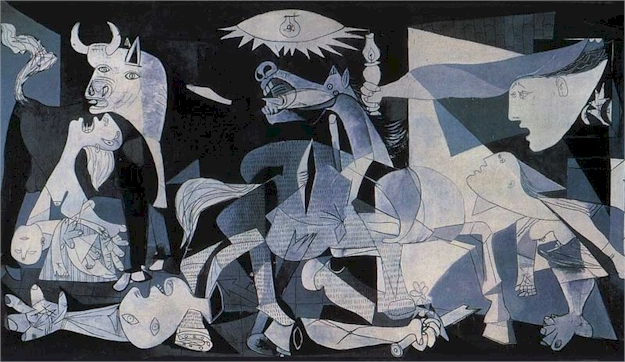
There were enough Americans outraged by the events in Spain during its civil war (1936-1939)to see the creation of what was called the Abraham Lincoln Brigade.  Along with thousands of volunteers in brigades formed in other nations, they voyaged to Spain to protect its elected government from attacks by fascist forces devoted to its overthrow.  Many of those fighters never returned home, killed in the ferocious battles that took place.  They were eventually cited as the first casualties in the war against fascism that would ultimately result in the deaths of tens of millions around the globe. The democracies of the world stood by and watched as the Nazi air force came to the aid of Francisco Franco's fascists, notably commemorated in Picasso's Guernica mural.  
 
I have often thought back to that historical episode when, in the face of injustices taking place, I try to deal with my own barely contained rage at policies our own government has pursued and is currently pursuing. I find it extremely difficult to stand by and be a witness to events that all of my reason and instincts tell me are wrong yet nevertheless go unopposed.  It is sometimes not enough to console oneself with Martin Luther King's observation that "the arc of history is long, but it bends toward justice." (Ironically, fascism in Spain far outlived the regimes in Germany and Italy, lingering until Franco's death. Some injustices clearly die hard. It would not be until Francisco Franco's death in 1975 that veterans of the Lincoln Brigade could return to a Spain finally free of fascism.) Perhaps, for children of the 1960s, the slow tread toward justice is a particularly bitter pill to swallow. We had tasted at least one victory when, in the same year that Franco had died, the puppet regime in Saigon fell to the North Vietnamese army. Though the war in Vietnam had gone on for decades, tens of thousands who had marched against American involvement felt that that they had had a role in bringing it to an end, that peaceful protest could have an impact.

It was a lesson not lost on American policy makers.  Never again would large segments of the American people mobilize peacefully against the grand design of U.S. foreign policy.  And there would be many such occasions when those policies could be called into question, particularly with the inception of the Reagan government in the 1980s.  (Although it should be pointed out that, even before Reagan, the supposedly pious "restoration" president, Jimmy Carter, was a thick-skinned cold warrior, initiating a secret war in Afghanistan that would have far-reaching consequences, not the least of which was the birth of Al Qaeda.)  By 1983, Reagan, (in a war that gave us the newly issued U.S. Army helmet, for some, rather alarmingly similar to that worn by German troops in World War II), was prepared to give us an unquestionable "victory" even if over a small island in the Caribbean most notable for being a diploma mill for for foreign medical students.  In the aftermath of Vietnam, our nation's military exploits would proceed unhampered by mass protests.  In Grenada, in Panama, in "secret" (secret only to the American public) wars in Central American nations like El Salvador and Nicaragua), and, outstandingly, in the so-called Operation Desert Storm, the Gulf War in 1990, the U.S. demonstrated that it would not be repeating the mistakes it had made in Southeast Asia.  No longer would free-wheeling war correspondents be sending raw footage home in time for the six o'clock news.  The end of the draft also ended anti-draft protests and substituted for the draft a "professional" army joined in battle by mercenaries handsomely compensated for their efforts with taxpayer dollars.   The safeguards against wars unilaterally declared by the executive branch that were put in place after Vietnam and were really no more than an underscoring of our constitution were ignored wholesale.  Journalists were "embedded" with troops and their reportage seriously constrained by the military.   Anti-war protests engendered by both wars in Iraq as well as the war in Afghanistan were feeble compared to those that accompanied the war in Vietnam.  Not only were we fighting an evil dictator or "terrorism" rather than a people's liberation movement, the motivation to take to the streets against wars being fought in our name was greatly diminished after U.S. Army troops had opened fire on protesting students at Kent State, killing four students and wounding nine more in a barrage of gunfire.  At the conclusion of the Gulf War, U.S. forces could, without fear of domestic criticism, leave a "Highway of Death" littered with the corpses of massacred thousands retreating from Kuwait on their way back to Baghdad.  We had entered a brave new world.
 

.And then, of course, we had 9/11.  It took ten years for the U.S. to find an enemy worthy of the trillion-dollar-a-year killing machine that the nation maintained even after the fall of the Evil Empire in 1991.  Of course, the war against the remnants of that empire had gone on unabated in the intervening years.  We would seize the moment, bury communism so deeply that it could never rise again.  With the help of Germany and Croatian fascists, with Tito gone, ornery Yugoslavia descended into butchery and became atomized.  Since, it appears, every American president must have his war, even Bill Clinton was persuaded to initiate a bombing campaign in the area, at one point "accidentally" bombing the Chinese embassy.  (The official explanation was that it did not appear on military maps of the area.  U.S. intelligence should have sought out a tourist map at a local hotel desk.)
 
       By the time Bush, Jr. entered the Oval Office, the Evil Empire had morphed into an Axis of Evil which included such threats as North Korea, (Goodbye, Sunshine Policy.), and dangerous Cuba.  Those roaring mice, of course, would never have invited the response to external threats that we would soon be treated to, a response that would transform the nation into an Orwellian nightmare with a tattered constitution that was twisted to allow for torture, rendition to foreign torture chambers, robot drone attacks out of The Terminator, and a new language, a glossary that seemed to come out of Goebbel's playbook.  Suddenly, we no longer had a nation, we had a "homeland," (heimat? vaterland?), and restrictions on human rights were euphemistically summed up in the "Patriot Act."
      Even before 9/11, however, it was clear as soon as the Supreme Court gave Bush the presidency and he announced his cabinet choices in December of 2000, that his was a war cabinet.  I can recall upon hearing that such as Colin Powell, Donald Rumsfeld and Condoleeza Rice would be joining Dick Cheney on his team that I ran down the hall from my office to a friend's office and cried out, "My God, he's chosen a war cabinet.  We're going to war!"  Rumor had it that Bush, the son, was obligated to deal with the unfinished business his father had left in Iraq.  All that was needed was a convenient casus belli and the games could begin.  It was not long in coming.
      It is not necessary here to sum up the events following September 11, 2001.  Ultimately, the neo-con cabal and the cowboys had to be reined in following disasters in Iraq and Afghanistan.  A caretaker government was in place well before the permanent government had installed another restoration president.  Rumsfeld would go replaced by Gates, a member of the Iraqi War Commission, who stayed on to be Barack Obama's defense secretary.   Bush had been declawed.  Though many of the trappings changed after he left the White House, and there was talk of withdrawal from Iraq and Afghanistan, it soon became clear that, Nobel Peace Prize notwithstanding, the new young president would continue the grander design.
 
Next:  Drones, the Arab Spring, Gaza, and the attack on the Hassad regime.
       

Thursday, November 08, 2012

Bubbles

I had the distinct pleasure of benefiting from the resources of two of New York City's elite high schools.  I attended Brooklyn Technical High School in the late 1950s, and then, after an already long career teaching English in other schools, had a twelve-year stint at Stuyvesant High School from 1992 until 2003, when I retired.   Although my formal education had been in the humanities, I have had a life-long interest in science, particularly in astronomy and physics, and, so, I came to enjoy the opportunity to have informal conversations with my students about some of the issues about which I had questions.  I can recall one such conversation in which I shared with a group of students my dismay and annoyance at the way science text books represent reality.  Based on these conversations, I got the impression that in the forty years (1959 to 1999) that had passed since I was a student that while science had changed a great deal, pedagogy had not kept pace.


      What exactly is a wave?  Throughout all of our schooling we are taught about waves--sound waves, light waves, radio waves, ripples in ponds and waves in the ocean.  The stylized radio antenna depicted above has been reproduced in countless texts.  What this iconic image purports to show is an antenna emitting radio waves.  What we actually see is a series of broken concentric circles with their source at the tip of the antenna.  I could never understand how those broken circles even came close to actually depicting waves.  If anything, I suspected, a more accurate depiction would be a series of concentric spheres, in effect, bubbles within bubbles emanating from the antenna.  Similarly, the often offered alternate image of ripples made by a rock thrown into a still body of water, a pond, seemed to have a similar drawback.   While it is true that, in this case, we seem to have advanced to both concentric circles and the standard image of a wave, if we take the added step of visualizing the ripples in cross section, our cross-section seems restricted to the surface of the water.  That is, the trough of the ripple/wave still does not depict what may be going on beneath the surface.  Even the oscilloscope, another standard device that is understood to depict waves electronically, seems merely to be a line of light having a certain amplitude and frequency (height or intensity and time period between pulses).
     Thus all three of the most common depictions of waves, namely fret lines, ripples, or squiggly lines of light on an oscilloscope's screen, seem merely to be shorthand methods of showing us what a wave is.  I struggled to find some way to better understand and visualize what was actually taking place.  I imagined a light going on in a room or a hand clapping.  In both cases, whether I was considering light or sound, it was obvious to me that there was no linear wave emission from either source.  Whether at the speed of light or the speed of sound, whatever was being created at the source reached everyone in the room regardless of where they were. Some way of illustrating something akin to an expanding sphere of some force or energy seemed to be called for.

When I found the image on the left, of a guide in a children's museum blowing bubbles within bubbles, what was going on seemed closer to what my instincts told me actually emanated from a point at which light or sound (and thus anything said to take the form of waves) might be depicted.  At this point, however, I had the sinking feeling that a knowledge of calculus might be a good thing to have.  I knew enough about the construct underlying calculus to know that it dealt with objects in motion.  Had I arrived at one of those junctures where only mathematics could express what was going on, and that what I wanted to see simply illustrated no more surrendered itself to pictorial explanation than all those rubber sheets and curving graph lines through black space could succeed in depicting Einstein's theory of General Relativity?
     I searched for one more common device that might help--a cheap fiber optic lamp.  (I have even bought one online so I can stare at it and await enlightenment.)  This last seems closest to what I envision happening when any object emits or even reflects light.  But where is the wave?
    I applied myself to the problem.  It now seemed to me that a combination of the bubbles within bubbles and the fiber optic lamp might offer a solution.   But there are problems.  If you turn on the lamp, you instantly see the points of light emerging from the end of each plastic fiber.  Given the speed of light, one would not expect to see the photons gradually traveling from their source to the end of each individual fiber.  It would be ideal, I thought, if one could make two important modifications to my table-top toy: first, slow down the speed of light to a degree that one could see the light travel from its center to the end of the fibers, and, second, so increase the number of fibers so that, rather than seeing pinpoints of light, the lamp would ultimately produce something closer to a perfect sphere of light.  If the light were traveling slowly enough what one would see is a gradual transformation--from a small sphere at the moment one turned on the lamp, to a larger sphere whose radius would be determined by the length of the fibers.
     You have probably guessed that my "solution" raised more questions than it answered.  When, in my conversations with students, I shared some of these speculations and offered that, ultimately, if we could actually see all of the waves in the room we were in, radio waves, television waves, X-Rays, ultra-violet rays,etc., coming into the room, bouncing off one another, reflecting one another, we would find that we were in a dense "soup" of bubbles and intersecting bubbles, (are those the strings of string theory?), a cosmic foam of bubbles, several of them told me that, "Hey, there are some scientists we have heard about who also believe in bubbles.  You're not alone."

...to be continued.


Wednesday, October 31, 2012

Still in the Labyrinth after Fifty Hours of Youtube Videos on Quantum Physics


“Philosophy [nature] is written in that great book which ever is before our eyes -- I mean the universe -- but we cannot understand it if we do not first learn the language and grasp the symbols in which it is written. The book is written in mathematical language, and the symbols are triangles, circles and other geometrical figures, without whose help it is impossible to comprehend a single word of it; without which one wanders in vain through a dark labyrinth.” 

--Galileo Galilei

Perhaps some of my blog correspondents will recognize the equation in the illustration to the left.  It is a very famous equation, almost as famous as Einstein's e=mc2, and it appears on tee-shirts available in college book stores.  Recognize it?  It's Schrodinger's equation.  You may recognize the name even if you didn't recognize his equation since he is famous for his thought experiment involving a cat in a box which, we are told, illustrates that, on a quantum level, the cat is both alive and dead at the same time.  Really.  Alive.  Dead.
      Although Schrodinger may be a bit esoteric, everyone has by now heard of the Big Bang Theory--even if only as the title of a TV sit-com.  (I will defer to another time the task of deconstructing that show for what it tells us about how the usual American stereotypes about science and scientists have "evolved" in the homeland.)   Ever since Einstein became science's first media star, it has become impossible to keep certain phrases from entering the vernacular.  Terms like black holes, inflation, the standard model, the uncertainty principle, entanglement, even, of late, Higgs bosons, CERN and particle colliders appear almost daily in the media.  Thanks to PBS's Brian Greene, we may add to the list talk of string theory, multi-verses, eleven possible dimensions and so on.  Millions have not only heard of Stephen Hawking and recognize the man in the wheel chair with the robotic voice; his book, A Brief History of Time sold 10 million copies.  (A remarkable publishing phenomenon, since just about everyone who has read the book admits to not being able to follow it at all.  More of this later.)  I guess it was inevitable that even Oprah managed to get into the act.  She invited physics professor Leonard Susskind onto her show a few years back to discuss the until then esoteric view that, contrary to Hawking's theory, all that seems "real" to us is actually a holographic projection of a two-dimensional matrix surrounding a black hole.  Which brings to mind movies like The Matrix, just one of a host of movies that, in a long film tradition, borrows freely from science and science-fiction alike.
      Now, let's get to Youtube.  There is no doubt that it is a wonderful resource.  A little patience circumventing a lot of clutter can reward you with a valuable companion to Google for the kind of learning one can achieve outside of, let's say, a university classroom.  In fact, both of these internet resources often allow one a kind of access to what is available inside our most prestigious universities.   Yale comes to mind, for example, as an institution that has placed on the web lectures by some of its most acclaimed faculty.  (The lectures on history are particularly good, often serving as a reminder of the limitations of lectures many of us attended as under-graduates.) Youtube allows you to watch everything from very short video material to full-fledged lectures lasting over an hour on a wide variety of subjects.  Given the luxury of free time, we are free to follow our own unique learning curve, surfing from one site to another, rejecting some material, lingering on others for hours.
     I have always been fascinated by cosmology and the knowledge claims of twentieth century physics.  Here, then, I hoped, was my opportunity to see if I could actually understand concepts like relativity, space-time, the wave/particle dichotomy.   I mean really understand, not just on the surface level that, for all their virtues, PBS and the BBC present, but with real insight.  And herein lies the rub.  What did I learn after fifty hours or so watching those Youtube lectures?   Not a heck of a lot.
     I am not ready to blame Youtube for my frustration.  Perhaps there are sites that would allow me to prepare better by spending time acquiring the necessary background in advanced algebra and calculus that would open more doors for me.  Because herein lies the rub.  There is simply no way that one can understand what it is these talking heads from the physics community are talking about without--to borrow the popular phrase--doing the math.   It has become a fixture of talks designed to explain science to the lay public that, undeterred, presenters will bend over backwards to assure their audiences that they will not be called upon to understand any of the math, any of the equations that are intrinsic to really understanding the subject.


A good many times I have been present at gatherings of people who, by the standards of the traditional culture, are thought highly educated and who have with considerable gusto been expressing their incredulity at the illiteracy of scientists. Once or twice I have been provoked and have asked the company how many of them could describe the Second Law of Thermodynamics. The response was cold: it was also negative. Yet I was asking something which is the scientific equivalent of: Have you read a work of Shakespeare's? 
 
I now believe that if I had asked an even simpler question — such as, What do you mean by mass, or acceleration, which is the scientific equivalent of saying, Can you read? — not more than one in ten of the highly educated would have felt that I was speaking the same language. So the great edifice of modern physics goes up, and the majority of the cleverest people in the western world have about as much insight into it as their neolithic ancestors would have had.
--from Wikipedia entry on C.P. Snow
 
      The above quotation is from a lecture delivered in 1959 by C.P. Snow which he titled, "The Two Cultures." I would argue that in the ensuing six decades since Snow gave his lecture very little has changed.  If anything, science has become more esoteric and thus even less accessible to the vast majority who are--dare we admit?--mathematically illiterate.  While, on the one hand, the only remedy to this problem seems to be the obvious, which is to say that, if you really care, you have no choice but to take the painstaking steps to acquiring the language of science, yet, and this is the real point in my writing this piece, I believe that more can be done, a great deal more.
     While Snow was presenting his thesis in 1959, I was a student at Brooklyn Technical High School where we were told by our English teachers that, (on the assumption that we were destined for careers in science and engineering), as future scientists and engineers, we had an obligation to learn how to express ourselves clearly.  While it was true that most Tech students would go with the program, stubborn recalcitrants like myself were placed in what they called the College Prep Program, a track that accomodated boys (only boys attended in those days) whose aptitiudes were more in the humanities.  We were bluntly told that scientists and engineers were notorious for their poor writing skills and their inability to communicate with anyone outside of the fold.  We were going to be different.  No one had to twist my arm to make me believe that this was not just a malicious stereotype since I found that both in the way math and science were typically taught as well as in the way math and science text books were written rote learning ruled.  All of my childhood curiosity soon dulled.  I was one of those boys who always took things apart to see how they worked, whined until I got a Gilbert chemistry set for Christmas, looked at the night sky with wonder, read science-fiction and loved dinosaurs.  At Tech, my grades in math and science nose-dived.  Rebellious and resistant to authority even as a child, I felt that my science texts were more catechisms than guides to true understanding and discovery. There is one bit of business in science texts which, though seemingly trifling, always left me frustrated and angry.

     ...I will discuss this and conclude this post in a blog to follow.
      

Tuesday, October 09, 2012

2001: Where's Stanley?

In 1968, and for several years earlier during the period in which Stanley Kubrick was working on 2001: A Space Odyssey, the time, many believed, was ripe to take a stand on the war in Vietnam.  This seemed particularly to be expected from an auteur who had made two earlier films (Paths of Glory and Strangelove) which, if they were not exactly pacifist statements, certainly seemed anti-war.  (Wikipedia's notes on Paths of Glory, in fact, reveal that the film so tweaked the noses of the military hierarchy in France and Germany that it was banned in those countries for years.)  Fans of the director just knew that if he set his mind to it, Kubrick was capable of making a devastating statement on the war.  Yet it took Kubrick another two decades before he got around to making a cinematic statement on the war in Southeast Asia (Full Metal Jacket, 1987).   In the first throes of absorbing 2001, it seemed that Stanley had decided instead to go cosmic on us, to take the decidedly longer view.   Kubrick, in fairness, was never a "topical" film maker; his work was literary, not journalistic.  He had, in fact, often turned to the novel for his source material.
     When, years later, it was reported that Kubrick's magnum opus was chosen to be ranked first among the Vatican's selection of the forty-five most influential films of the twentieth century, and that Pope John Paul II had hosted a private screening of the film, the news was greeted among many Kubrick fans with a reaction somewhat akin to the reaction that an earlier generation had greeted the Hitler-Stalin pact.  (Or, if that comparison seems a bit overblown for you, think Bob Dylan turning to Jesus.)  By that point, however, we were not entirely surprised; we had had time enough to digest the fact that, great as the man was, grateful as we were to him for so much that was unforgettable in his work, the Stanley of our youth had proven to be a fiction.

     As I alluded to in an earlier post, these musings were triggered anew for me when I attended a screening of The Shining hosted by the New York Times.   I had some time ago come to the conclusion that essentially all of Kubrick's work played out on the level of dream rather than reality, and, of course, once one is prepared to view a film as a dream sequence, there are very few rules with regard to verisimilitude.  Certainly,  Eyes Wide Shut (1999), Kubrick's last work, was far from cinema verite.   But there is a scene in The Shining that brought home for me Kubrick's essentially supernatural vision.  After attacking his wife, Jack Torrance is subdued by her with a swing from a Louisville Slugger and then dragged to a food locker for safe keeping.  Now, most of this film can be viewed as a psychological drama, the scenes being played out for us taking place in the fevered imaginations of the main characters.   Jack's escape is pure magic.  Almost as if out of embarrassment at using the plot device he descends upon to get Jack out of the locker, Kubrick does not show the bolt on the lock miraculously ascending; instead we only hear it jolting out of place.  Ghostly twins and rapids of blood may exist in characters' minds, but locks don't get unlocked by themselves.  We have left the realm of psychological drama and entered a metaphysical realm.  Or at least it was a metaphysical realm until Heisenberg and quantum mechanics asked us to accept that anything is possible.  While you are calculating the probability of a lock opening by itself, let us turn back to 2001.

I put out my cigarette, and went back into the theater to see just where Kubrick would take us on that memorable night in April of 1968.  You may recall my having turned to my wife and saying during the film's intermission, "If the second half of this movie is anything like the first..."  Well, by the movie's end, (yes, I know, I'm calling it a movie), Keir Dullea's fetus was spinning and filling the amniotic fluid of the cosmos, mankind reborn.  My head was spinning, too.  What hath Stanley wrought here?  Was this poetic metaphor or were we being asked to believe in divine intervention?
     And then reality overtook poetry.  We crowded out into the night air of Times Square, and I saw a passing pedestrian, his head buried in a copy of The Daily News bearing the bold headline, KING DEAD.   It took me a moment, unbelievably, to figure out which King the headline referred to, but any doubt about who had died could not have survived the subway journey on the A train back to Brooklyn Heights in a subway car filled with silent Black men and women barely able to contain their rage.  We rushed home to turn on our television set, our first Sony Trinitron, newly capable of showing--in living color--television newsmen reporting from one American city after another against a backdrop of red/orange flames reminiscent of one of Hieronymus Bosch's visions of hell.  Just a typical twenty-four hours in 1968.  Life had become more vivid than art, had overcome art to the point where even Kubrick's call for attention would have to wait.  There were still eight more months of 1968 to live through.  1969 would bring the abyss--Nixon, Chappaquiddick, Woodstock, the bombing of Cambodia, and, of course, the landing on the moon.  Rumor had it that Kubrick had helped stage the event on a Hollywood sound stage.  Who knows?  Post-modernism had begun and in the closing days of that year, it was announced that Valium was the most prescribed drug in America.  And so it goes.

Monday, October 08, 2012

Existential Nausea Comes to the Movies

In the instant that tall, slate gray monolith miraculously appears for the first time in 2001: A Space Odyssey, I learned what it meant to be overcome by the chill recognition of lost love and betrayal.
     By 1968, events in the real world had begun to catch up with Kubrick's prophetic cinematic visions of where we were going.  In a real sense, we had been prepared for the insanity of the war in Vietnam and the military industrial complex first in Paths of Glory and later in Strangelove, and the streets of cities around the world were now filled with Hobsbawm's "primitive rebels."  Young, bright-eyed Kirk Douglases were everywhere leading their cohorts out of (at least mental) slavery from Prague to Mexico City to Paris and New York, playing out their own version of Spartacus.  The cataclysmic events that shook the world in 1968 were only beginning in April of that year--far, far too many to list here, but just as a reminder: we witnessed the assassinations of both M. L. King, Jr. and Bobby Kennedy (among others), the Tet offensive, the Democratic National Convention, the Prague Spring, the massacre of students in Mexico City, the Cultural Revolution in China in full swing, the Paris Riots, the police attack on Columbia University.  One came to fear calls in the night for what they might report.  The year came to fully earn its label, "the year the world ended."
      It is difficult to recreate the excitement and anticipation with which many of my generation looked forward to the release of 2001.  It had the promise of being Kubrick's masterwork.  Rumor had it that it was so long that Kubrick was still editing the film up to the very eve of its release.  It would have its New York premiere in one of the large movie houses in Times Square that still dotted the area.  At the time, my wife was working for Cambridge University Press, and I was teaching in what was then called a ghetto junior high school.  We planned the evening carefully.  I would meet her in front of Carnegie Hall, just outside of the 57th Street subway station, timed to get a bite to eat before the movie and then walk over to Times Square.  The events of that evening came to forever encapsulate for me the experience of the sixties.


 Left: President's Daily Diary for April 4, 1968 indicating that at 5:09 p.m. he would board the presidential helicopter in Central Park's Sheep Meadow.  He was in town for the installation of Cardinal Cooke, who succeeded Cardinal Spellman.


    When I emerged out of the train station and took a seat on the steps of Carnegie Hall, New York Times' article on Kubrick in hand, I found that 57th Street was lined with police barricades.  A by-stander told me that the president was in town and his motorcade would soon be passing by.  Within a very short time, black limousines began to appear, red lights flashing.   Someone pointed out the presidential helicopter hovering above and then descending into nearby Central Park.  The air was electric.  By this time in his administration, Lyndon Johnson was everywhere being greeted by mobs of young people chanting, "Hey, hey, LBJ, how many kids did you kill today?"  On this occasion there were no crowds in evidence.  Soon, a long entourage of dazzling police motorcycles signaled the approach of the presidential limousine, and, colorful flags waving, lights shining, it suddenly appeared.  LBJ and Lady Bird must have had the limo's interior lights on because one could clearly make out the president and his wife, smiling and waving at curbside onlookers.  (Whenever I saw the president at a demonstration in New York, I always marveled at how handsome he appeared, his tan skin set off by an almost blindingly white shirt.)  One young man standing at my side made a move that seemed intended to throw himself at the president's car, but he was instantly pushed back by a cop.  For a split second, it seemed the president reacted.  And then the show was over.
     When my young bride arrived just a few minutes later from her office, she found me in an excited state that seemed excessive even for a Kubrick aficionado about to see one of his movies.  We walked across Seventh Avenue to a small restaurant, and, over a hastily consumed meal, I told her what I had witnessed just moments before.  My hands were shaking.  I ordered a scotch.
     In the event, 2001: A Space Odyssey turned out to be at least as prophetic as Kubrick's earlier work.  The problem, as we shall see, is that he would himself be party to those events, events which would eventually prove to leave the "Left" everywhere besieged and cast into disarray.  2001 was, in effect, a shot across the bow of an entire intellectual construct that, in 1968, the smoke of rebellion everywhere in the air, seemed to promise revolutionary change.  We would come to look back and realize that Paths of Glory ends in the death of innocents, Spartacus ends up crucified on a Roman road, and Slim Pickens' misguided (no pun intended) patriotism triggers our Mutually Assured Destruction.  Humanity seemed incapable of altering its condition--at least without divine intervention.
     If we turn to one of the fractals of American culture in the years leading up to this sea change, we might find in another science-fiction work popular with the young of the time, television's Star Trek, a swan song for classical Marxism and materialism.  Star Trek, at least in its earliest manifestations, was almost pure science, almost always drawing writers for its various episodes from the Old Left.  Aside from occasional lapses into silly plots designed to keep up ratings, what happened on the show, strange as those events may have seemed, at least had some roots in material possibility.   After 2001, however, the floodgates of Hollywood opened to a deluge of barely disguised mysticism.  George Lucas's Star Wars was warmed-over Christian myth pretending to be science fiction.   From that point on, until this very day, American culture has been drowning in vampires, ghosts, angels and superheros with superhuman powers.  But it was not in the United States alone that the phenomenon occurred.
      Science, until this period, was a construct at least popularly held to be in rational opposition to virgin births, resurrections and other such products of fevered human imagination.  In the world of physics, it would turn out, only Albert Einstein (who would come to be somewhat pejoratively--if not pathetically, labeled a "neo-realist") would attempt to hold the fort against a quantum world in which we are told that anything is possible.   With Einstein spiritually at their side, some left theoreticians would struggle to point out that historical materialism was never purely deterministic, that Marx's materialism was dialectic rather than some simple-minded linear cause and effect.  They proved to be voices in the wilderness, lost in one of the alternate universes that the sages at MIT and the Planck Institute had theorized.  Heisenberg, already hated by the left for his cozy relationship with Hitler and the Nazi's minister of armaments, Albert Speer, replaced the long arc of history steering toward justice in one blow with his Uncertainty Principle.

     The movie was spectacular.  Shown on a vast wide-screen in a huge theater, it overwhelmed the viewer with its images, its music, its view of the future both playful and deeply profound.  Because it was so long, there was an intermission.  The first half of 2001 was already like no "movie" anyone had ever seen.  As we watched an animal bone ascend--now thanks to the intervention of the monolith having morphed into its inevitable function as tool (or, more accurately, weapon)--we saw summed up for us 2,000,000 years of human evolution.  And oh, that spinning wheel of a space station on a screen so large and wide it seemed to engulf the viewer, luminescent against the blackest space, being approached by a space vehicle to the strains of a Strauss' Blue Danube waltz, further summing up all human accomplishment.  On to Jupiter!  I turned to my wife, reaching for a much needed cigarette and said, "Honey, if the second half of this movie is anywhere near as good as the first half, we are going to be blown away!"  And, as we shall see, we were indeed.

Here's Stanley!

       In 1996, to commemorate the first centenary of motion pictures, the Vatican published a list of 
                45 films that it considered of special merit.  Heading the list was Kubrick's 2001.  Indeed, Pope 
                John Paul II hosted a screening of 2001 at the Vatican on the occasion of the movie's worldwide
                release during the year 2001. 
                                                                     
                                                                          -- Gene D. Phillips of Loyola University, in his introduction 
                                               to The Encyclopedia of Stanley Kubrick, written by Phillips and Rodney Hill.


The New York Times Theater gave a special showing of Stanley Kubrick's The Shining last night, and I found that my patience with one of my old heroes had finally reached the breaking point.   The honeymoon, or perhaps more accurately, the artistic marriage was finally over.  Nevertheless, I will always owe Kubrick a great deal for the changes his work wrought within me as far back as my early adolescence.  What had gone wrong?

     For many teenagers growing up in the 1950s, "going to the movies" was a Friday night ritual.  Loew's Premier (pronounced pree-mee-er by the locals) was located on Sutter Avenue in the East New York section of Brooklyn.  Not the most baroque movie house, not nearly as elaborate as, for example, the nearby Loew's Pitkin in Brownsville, the Premier was nevertheless an archetypal movie palace replete with baroque trappings and an unforgettable Italian renaissance pool of goldfish in the center of the lobby.  Each Friday night saw the place filled with teenagers present as much to scope one another as the latest reels from Hollywood.  Everyone dressed for the occasion, doused themselves in perfume or cologne (Chanel on the girls; Canoe on the boys) and puffed away on Kent cigarettes looking, we trusted, every bit as cool as the movie stars who were our models.  Today, a white teenager would stand out on that corner of Sutter Avenue about as much as a giraffe in Antarctica, but in those days the street was a lower middle class version of the Miracle Mile, resplendent with ungated shop windows lit through most of the night for the perusal of strollers.  (I was recently rewarded for my trip back to the old theater to find the vista of an empty, rubble-strewn lot amid the surrounding ruins of what was once a vital thoroughfare.  An idle group of black men looked on curiously as I got out of my car to take a picture.)  To no small extent, Kubrick's genius lay in the fact that the virtually cataclysmic events that would, among other things, spell the end of American cities as we had known them, come to resonate in one after another of his films.


      And film is the key word here.  I no doubt missed the distinction between movies and film through many earlier trips to the Premier, but for me and many others of my generation,  at least those of us who read books, Kubrick's Paths of Glory was a breakthrough event.  Although our jaws dropped merely by virtue of its cinematography, its screenplay played out more like literature than a movie.  We had seen Kirk Douglas many times before, as a cowboy, a boxer, even a Viking, but we had never before seen him in a role that made him more the protagonist of serious novel than a mere leading man or movie icon.  The scenes of battle resembled newsreels more than staged events--grainy, jumping about in a manner that suggested a hand held camera even before we were aware of its possibility as a technique.   More than anything else, though, the poignancy of the injustice it portrayed excited our newly emerged, raw, adolescent awareness of the evils of which authority was capable.   For us, Kubrick was a man who dared to tell the truth, the eternal holy grail of adolescent seekers.
    Paths of Glory (1957) was released when I was in my first year in high school.  Eisenhower was in the White House and the young Elvis was debuting on the Ed Sullivan Show.  Kubrick's next major film, Spartacus (1960), came out just as I was starting college and a fairy tale prince was entering the White House.  If there was a ticking time bomb barely audible beneath the surface of events during those much vaunted "happy days," (nightmarish echoes of The Great Depression and World War II that--in spite of every effort to deny, repress and sublimate--clearly lingered alongside, within a very short period of time, the real bomb, Korea, the Cold War, McCarthyism, the Rosenberg executions, growing racial tension and the "Beats," just to cite the most obvious),  that bomb would finally explode with, to switch metaphors, young Jack's brains bursting forth like the newborn Athena out of Zeus's head, shouting a call for violence and war.

      Like all works of genius, Kubrick's pre-1963 films came to seem prophetic, at least well ahead of their time.  My generation, later to be labeled "the New Left," during that time had yet to be tutored by the Old Left of the 1930s to more fully understand the politics of Spartacus; we had not yet heard of Rosa Luxemburg or read E.J. Hobsbawm's Primitive Rebels or the essential Marx and Lenin.  Nor should one overlook the fact that it was during this same period that students and college educated Americans were being exposed, in the then still extant abundance of small "art houses" complete with complimentary espresso and cookies served in their lobbies, the emergent post-war products of the Italian, French and, outstandingly (even if somewhat surprisingly) one particular Swedish director.   The work of such as Fellini and Antonioni, Truffaut and Bergman clearly consisted of films rather than movies and were treated with the appropriate reverence.  Yet, for American film lovers, Kubrick had a special status.  He was an American; he was ours; he came to speak for us.

     Kubrick's first post-Kennedy assassination film was Dr. Strangelove (1964).    By 1964, a mere seven years after the release of Paths of Glory, enough admirers of Kubrick had gathered to create an atmosphere of great anticipation when word got out that another of his films was to be released.  Even before Strangelove, a good part of the excitement about Kubrick that had begun to form was that he was, in a word, a child of the left, at least if being a leftist was synonymous with being anti-war, anti-establishment and anti-Hollywood commercialism.  His films seemed to be in a symbiotic relationship with the young left who were still honing their ideological mind-set, at the same time influencing our thinking and giving us, shall we say, moral support.  By the time, at the conclusion of Strangelove, Slim Pickens rides a nuclear ICBM waving his cowboy hat on his descent to oblivion, we were convinced that Kubrick spoke for us.  Embedded in the trappings of a dark comedy, Kubrick had exposed the military industrial complex and subjected it to a kind of derisive laughter that not even Chaplin had achieved in his pre-war satire of fascism, The Great Dictator.  And, though satire, Kubrick had also embedded in this latest work, once again in black and white, chilling, jarringly realistic scenes of battle (as U.S. troops attempt to take back one of their own bases from a paranoid general determined to take out the Soviet Union) that prefigured the television footage from the jungles of Vietnam that would soon be seen every night on the news for the greater part of a decade.
     Four years later, in 1968, Kubrick would release the film that would later be cited by the Vatican as first among the forty-five most outstanding films of the twentieth century.  2001 was released in a large movie house in Times Square.  On that very same night, crowds left the movie, still somewhat dazed by its impact, to receive yet another shock. The Reverend Dr. Martin Luther King, Jr. had been assassinated,shot to death on the balcony of  a motel in Memphis, Tennessee.
     The year 1968 would come to be called "the year the world ended."  One thing that certainly ended for my generation, as we shall see in the next post, was our adolescent fantasy of a marriage, even a marriage to art, that was free of complications.