Wednesday, February 27, 2008

Death of a Christian Knight

Communism had no greater foe than the Catholic Church. From the time of the Reformation and, later, the period of the French Revolution, Rome understood that its battle with those who marched under a red flag posed what is nowadays called "an existential threat" to its existence. Although liberty, equality and fraternity had been put to rest in 1815, two hundred years of seething ferment in the West ultimately produced the Russian Revolution and the very real possibility of the old guard being entirely eradicated around the globe.


Now, not quite twenty years since the demise of what some might call the great socialist experiments, those of all political coloration have begun to come to terms with what appears to be the victory of "free enterprise" in every corner of the globe with the exception of such roaring mice as Cuba, North Korea and the Islamic protestors against modernism. Most of us were taken by surprise. Prior to the fall of the Berlin Wall, who on the left would have, could have predicted the demise of communism? Yet, when it occurred there was no shortage of those who would make claim to having foreseen its inevitability. The New York Times celebrated the occasion by giving space on its first page first to one of its own, the late R.W. Apple, who called it the greatest historical event since the revolutions of 1848. Then, upping the ante, the Times gave the same space to Solzhenitsyn, who proclaimed that what we were witnessing was not merely the fall of the Soviet Union but the demise of the whole romantic revoltionary tradition, that what events illustrated was that the ideals of the French Revolution of 1789--liberty, fraternity and equality--were at bottom incompatible.


There have been many candidates for hero of the counter-revolution--from Pope John Paul II to Ronald Reagan, from Milton Friedman to Margaret Thatcher--but many Americans will harbor the not so secret suspicion that but for William F. Buckley and his influence, the hammer and sickel might still be waving above red square and half the people on the planet.


Bill Buckley was indeed the ultimate Christian knight, so much so, in fact, that I suspect he knew the truth about himself and his movement. He was too much of a gentleman to tell a really big lie.

The truth is that none of these figures can truly take credit for the victory of capitalism. That capitalism wins all of its battles through the reckless application of capital itself. Money talks.

Friday, February 22, 2008

On the Other Hand...

not all of the apparatchiks of the Bush administration are without ego. R. Nicholas Burns can be counted on to function as the official liar of the White House. He is a champion at disinformation presented with a winning smile. He is also proof that there is in fact a permanent government, since Burns served as ambassador to Greece.

When Israel was bombing the hell out of Gaza and then invaded Lebanon, it was little Nickie's role to repeat as many times as he could in as many media venues as would have him, "Hezbollah started it." This is the dark side with a smiley face label.

Although he has supposedly resigned from public service roles which essentially had him looking for ways to antagonize reason in the Middle East and Eastern Europe, he has surfaced to go on the record in support of Kosovan independence. This should be rich. If anyone wants to know what is really going on in that section of the world, read Chalmers Johnson. In his work, he alludes to the fact that the military base in Kosovo (a five star accomodation for our fighting men and women) is in a class with the Great Wall of China for the ease with which one can spot it from outer space.

Even Jeffrey Sachs' "shock treatment," it appears, was not enough to entirely subdue the Russians, so now we will really teach them a lesson. We have more sabers rattling through the air right now than a performer at the Peking Opera. Missiles in Belarus and the Ukraine, Kosovan independence, shooting down errant satellites. Prod the Russians enough, and who knows, we could get a real war going.

Tuesday, February 19, 2008

Who Are Those Guys?

You know, when men in real authority need attack dogs, the quality they most seek is loyalty. A corollary of loyalty of the kind that is required to carry out dirty jobs is a high threshold for disapproval. There are men who are used to not being admired for their charm, who, knowing this, will be determined to succeed, to allow success to serve as compensation for lack of grace. Such men are dangerous men. They simply don't care what people think of them. In Gonzales, Chertoff and Mukasey we have men who are emblematic of the type.

Need to work outside of the constitutional framework, Mr. President? No problem. Need to stonewall, temporize, resort to equivocation, be disingenous, use Orwellian language? None of these are a problem. I'm the man for you.


If the day comes when I have to fall on my sword, swallow the bitter pill, you will be able to count on me. I will take the bullet for you.
This will not make me attractive, not make me appear heroic in the eyes of most men, but they always looked upon me with disdain in any case. What I will get in return is a page in the history books. What I will get in return is the opportunity to be in a position of such power that I will be able to put some of the charmers in their place. What I will get is the sweet smell of the power trip that I could not get any other way. When I enter a Georgetown restaurant, the taste of the Bordeaux will be all the sweeter for the knowledge that there are men and women in the room who recognize me and who recognize in me the power to destroy.

Tuesday, July 17, 2007

The Fears of Stoddard Linger

Rather than see a decline in the birth rate as a good thing, nations in such "straits" often turn to economic incentives aimed at inducing their citizens to procreate. Someone out there may be writing to the effect that a decline in the population (both its rate of growth and its actual numbers) should be celebrated, but if so, I have yet to come across such sentiments. There is plenty of evidence on the other hand of panic setting in in various European capitals (or their offshoots in the former colonies) when there are fewer white babies being born:


Germany Plays With Procreation’s Price Point
By Mike Nizza
Tags: aging, europe, foreign affairs


Days after The Lede’s look at declining birth rates in countries around the world, from Asia to the United States to Europe, The Financial Times is reporting some contrarian news on fertility from Düsseldorf, Germany:
In the first quarter of 2007, nearly 15 percent more babies were born in Düsseldorf than in the same period last year. The Kaiserwerther Diakonie, one of the city’s three large hospitals, reported a rise in births of more than 16 percent in the first half of the year.

While noting that it is too early to declare a trend, The F.T. nonetheless lists some possible explanations for what a German newspaper is calling “a new baby boom.” Along with a stronger local economy that is attracting young couples, a policy known as Elterngeld is held up. The Elterngeld program now offers subsidies of as much as 25,200 euros ($34,700) a year to mothers who bear children in the year 2007 and beyond. Before this year, the subsidy was set at 7,200 euros ($10,000), leading to reports that mothers were
delaying labor in December 2006, hoping to qualify for the extra cash by giving birth in the new year.
Germany’s policy was inspired by its Scandinavian neighbors, who offer even more munificent benefits to new mothers. They also enjoy stronger birth rates. A BBC graphic
outlines Europe’s various offers.
The possible success of the higher payment in Germany and elsewhere in Europe prompts a question of procreation’s price point. How much would it take to induce you to have a baby? And can your government afford to fuel a new baby boom while taking care of the original baby boomers?


Supposedly, the economic pressures to maintain population growth are real. That is to say, if we put aside purely blatant racism as the motivation to encourage essentially white demographics, various arguments are made the aim of which is to convice us that not only is a growing population a good thing but also a necessary thing. Among those arguments is the notion that great powers must have large populations. Another is that, as populations age, that is, as the older citizenry represents a larger and larger percentage of the total population, more babies must be produced so that they can pay for the maintenance of their elders through the various tax or social welfare programs. Of course, from the perspective of a consumer society, there is yet a third factor--and perhaps this is the most important--fewer people mean fewer sales.

In the ensuing segments of this essay, I will try to address each of these factors. I will only say here that all of these factors must be measured against what I consider to be the over-riding issue, namely, there are just too many people on the planet right now. Sooner, rather than later, the disastrous impact of the estimated six billion of us that presently tax the resources of our planet will undoubtedly make itself felt, perhaps in ways that we have not yet been able to imagine. A paradigm shift is necessary if human life is to be sustained in a manner that allows us to cohabit with rather than exploit to the point of extinction the organisms with which we reside.

Thursday, June 21, 2007

Population Control: Good Old Days

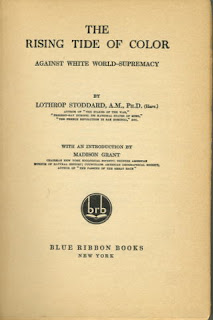
In the good old days, books could--without fear of reprisal--be titled, The Rising Tide of Color Against White World-Supremacy. Lothrop Stoddard's book would achieve a kind of immortality it would not otherwise have had when F. Scott Fitzgerald presented his portrait of a certain strain of WASP American in The Great Gatsby:


“Civilization’s going to pieces,” broke out Tom violently. "I’ve gotten to be a terrible pessimist about things. Have you read ‘The Rise of the Colored Empires’ by this man Goddard?”
“Why, no,” I answered, rather surprised by his tone.
“Well, it’s a fine book, and everybody ought to read it. The idea is if we don’t look out the white race will be—will be utterly submerged. It’s all scientific stuff; it’s been proved.”
“Tom’s getting very profound,” said Daisy, with an expression of unthoughtful sadness. “He reads deep books with long words in them. What was that word we——”
“Well, these books are all scientific,” insisted Tom, glancing at her impatiently. “This fellow has worked out the whole thing. It’s up to us, who are the dominant race, to watch out or these other races will have control of things.”


Perhaps it was legal considertions that forced Fitzgerald to thinly disguise the Stoddard work. He may have altered the name of the author and the title of his work, but Fitzgerald was not fabricating contemporary attitudes toward non-white peoples. This was also the period in which the eugenics movement had begun to flourish here in the United States, and Jack London could unblinkingly write of "The Yellow Peril." The concluding sentences of that work have echoes in current political reality:

The world is whirling faster to-day than ever before. It has gained impetus. Affairs rush to conclusion. The Far East is the point of contact of the adventuring Western people as well as of the Asiatic. We shall not have to wait for our children's time nor our children's children. We shall ourselves see and largely determine the adventure of the Yellow and the Brown. (Italics mine.)

It is interesting that though he titled his essay, "The Yellow Peril," London did not fail to include the similar threat posed by the growth of the "brown" races. A bit later in the twentieth century, however, the racial policies of the Nazis and the Fascists gave such phrases as "white supremacy" and the "master race" decidedly horrific connotations, and such terminology fell from use--at least in polite public discourse.

The truth is, however, that discussions of population control are still regularly cast in terms of race or ethnicity. In addition, given capitalism's need for markets and cheap labor, one would be hard pressed to see in print--or in any other medium--the advantages of a nation or the whole globe, for that matter, limiting population growth. Religion, race, politics and economics all come to play in discussions of population. Viewed strictly in terms of the health of the planet, this should not be the case. The very term ecology implies that there is some ideal balance of population, available resources and the health of the ecosystem.

What the environmentalists of our own day make painfully clear to all but those who profit from ignoring the reality is that there are too many automobiles, too many smoke stacks, overproduction of agricultural products, overfishing of the seas, disastrous incursions into wetlands areas, virgin forests and rain forests, scarcity of potable water, irresponsible building of dams...

(To be continued)

Tuesday, June 19, 2007

Population Control III

While popular journals of the 1960s were showing more and more of the planet going "red" and it looked like the Soviet Union would encroach on more and more of the planet, a threat emerged that, in the opinion of many self-appointed protectors of the "free world" represented at least as onerous a threat: the pill. For a brief period of time, this chemical innovation threatened to undermine one of the bulwarks against anarchy, chaos and communistic "free love" -- the fear and trembling associated with sex and unwanted pregnancies. The Catholic Church, long a leader in the campaign against sex without fear, long a leader in the campaign against the dangers of self-realization at the expense of patriarchy and authoritarianism, and just as long in favor of the pacifying effects of submission and obedience, was at the forefront of the battle against family planning. In the more developed world, nominal Catholics disregarded the injunction against contraception with abandon. The oxymoronic anathema placed upon the right of a woman to terminate a pregnancy while, at the same time, prohibiting women from taking steps to avoid unwanted pregnancies was not lost on many of the otherwise faithful. But, just as the Catholic Church and its allies in other religions had sought to make their theology a matter of law with regard to abortion, that is, prohibited to all, not merely their own flock, it followed a similar course with regard to birth control. That position, more a political than a theological one, has come to fruition in the administration of George Bush, whose programme has emerged as one of the most reactionary since the Spanish Inquisition--torture and all.


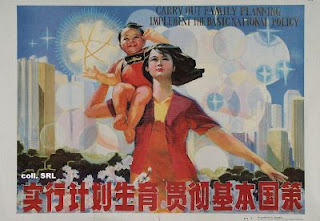
Even prior to the current Bush regime, however, the battle against rational family planning had been furiously pursued. Starting at the time of the Reagan administration one heard less and less about birth control or population control. Abortion here in the U.S. was portrayed by segments of the Black community (who, in fairness, had been the tragic victim historically of various sexual experimentation) as a covert form of genocide. Population control efforts in India, for example, were at the same time, portrayed as racist or misogynistic. When China, historically alarmed at the prospect of feeding its billions, resorted to its one-child policy, the policy was depicted in the West as a fascist-like intrusion into the lives of its citizenry, with scenes of women being dragged to abortion clinics out of their rural cottages frequently shown on Western television.
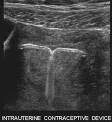
What all of the propagandizing against population control efforts could not accomplish--the moral inveighing against abortion, the alleged dangers of the contraceptive pill, the intra-uterine device, the diaphragm, vasectomy and tubal ligation--the emergence of the HIV/AIDS crisis did. The era of sex without fear was ended with a vengence. This was so much the case, the disease had begun to take so many victims, that there were some who saw in the mysterious emergence of this modern plague the shadow of conspiracy. Traditonal opponents of birth control had always had as another of the tenets of their faith the injunction against homosexuality. The politicization of sex was interwoven into the fabric of law here in the U.S. There were laws against sodomy and antimiscegenation just as there were laws against the mere distribution of information about birth control methods. (An ironic footnote to the notion that China was inappropriately interfering in human rights.) Now, some saw in AIDS the hand of a vengeful god delivering his wrath against homosexuals and later, we came to understand, drug users sharing their needles. Soon, however, women were turning up with the disease.

The pill had rendered condoms more or less unnecessary. AIDS made condoms an imperative. Unwanted pregnancy was not the issue, but failure to use a condom could spell a sentence of death or a life shortened by a debilitating disease. While the medical community continues its efforts to find a vaccine and expensive drug cocktails keep most in the developed world alive, AIDS has begun to ravage many African nations. (In a feeble and transparent attempt to appear humanitarian, George Bush pretends concern here while standing by as one African nation after another falls prey to genocidal internecine political conflicts, the heritage of centuries of colonial rule. For the U.S. and the European powers who raped and plundered the sub-Sahara of its wealth and now essentially stand by, hands in their pockets, silent witnesses to the aftermath of their colonial adventures, this is a form of birth control they can live with.)

In Europe, the United States and others of the developed areas of the globe, Malthus has been disproved on a grand scale. If anything, the left critique of Malthus, namely that as a society develops there will be natural checks on the birth rate, is now seemingly vindicated. In Italy, where the bambinos were traditionally adored, middle class affluence has soured a society drugged on the delicacies of a consumer culture to the messiness and inconvenience of child rearing. Babies get in the way. Italy now has the lowest birth rate in Europe. In Russia, both the birth rate and life expectancy have gone down precipitously by modern standards, as alcoholism and depression take their toll in the wake of the failure of the soviet experiment. As developed nations try to digest changes in the role of women and a redefinition of family, ( a still evolving story), the imperative for cheap labor must be attended to, and thus immigration from the poorer nations must be tolerated.

While London, Paris and New York, now as much as Tokyo, indulge in $200 sashimi meals, almost eradicating blue fin tuna from the oceans, much of the world is still hungry, poor, and obviously procreating like crazy. In many quarters, this tendency of the poor to multiply is seen as a threat--Latinos and Chicanos in the U.S. or Palestinians in the Israeli occupied territories for example--but, over all, unchecked global capital now sees either growing markets or a seemingly endless supply of cheap labor. Thus, we now have the perfect confluence of reactionary forces--the moral whip of poverty and the economic whip of greed.

Some Americans can remember when "Made in Japan" was synonymous with cheap goods. We are already in the period when "Made in China" has gained status and is giving way to manufactures from such venues as India, Indonesia or the Dominican Republic. No, there will be no cry for population control. Scarce workers mean high wages and lower profits. Scarce populations mean smaller markets. Like all games of "chicken," however, this game carries with it the prospect of death or disaster--in this case, for the whole planet. Just as much as it was when Malthus cast his baleful eye on the global economies, the race is between limited resources and potentially unlimited appetites.
The truth is that we have now had enough time to see the future and to know that it doesn't work. The automobile is a blight on the planet. Even fuel efficient cars would continue to use up the lion's share of dozens of other limited resources in their production and pave over the landscape with roads. The U.S. is the most egregious example, particularly in its subsidizing fuel-guzzling automobiles while starving rail and other public mass transportation. Once seen as the answer to sprawl, the high rise building is either an unsafe environment in which to live and work or--even in its supposedly "green" manifestations, expensive and dehumanizing. All those miracles of food production are slowly killing us, making of our planet the setting of a dystopian novel. As the poor multiply, they tear down trees to make way for the plots they need to plant to sustain themselves, gradually denuding the planet of virgin forests and all of the varied life forms they are home to. For now, it is goodbye polar bears. Soon, unless the population of this planet is checked and even much reduced, it will be goodbye ladies and gentlemen. Greed will have done its work and the life form that came to fancy itself located on the Great Chain of Being just below God and his angels will give way to the flora and fauna we fancy ourselves so superior to.

Population Control II


As of right now, there are far more people alive than our planet can accomodate. Another two to three billion will spell a disaster far worse than what we have to fear from other global threats. Desert golf courses with man-made water hazards are emblems of how commerce over-rules common sense. There are more and more news stories chronicling the tendency to privatize water here in the U.S. and in other nations around the world. In effect, air is already privatized since, outside of rural areas where pollution is not as great a problem as it is in the inner cities, communities with fresh air tend to be those with the highest income levels. In New York, Mayor Bloomberg is attempting to initiate a so-called congestion tax which would set up barriers to all but the most affluent drivers thus preserving an enclave, what in Mexico is called a zona rosa for the richest New Yorkers. The borough of Manhattan, no less than the desert golf course, has come to be a locus of unimpeded over-development. No empty lot, former parking lot or block of older buildings is safe from being converted into a luxury apartment building. Little regard is given to aesthetic considerations although Bloomberg disingenuously presents himself as an advocate for "green" buildings. Rather than impose limits on building in Manhattan, the mayor chooses to keep all but his fellow upper class cohorts out.
Since the Reagan/Thatcher counter-revolution against socialism was initiated and then replaced by globalized capital, the tendency to privatization has proceeded apace on every continent. Since the idea that "a rising tide floats all boats," (one of the conceits that drives this school of economic development), became the catch-phrase for international capitalism, it has become clear that, like Orwell's insight that "some are more equal than others," some boats are far more sea-worthy than others. (Coincidentally in keeping with this metaphor was the Chinese notion that leaving a state-run industry for the vagaries of the private sector came to be referred to as "jumping into the ocean.") The Chinese quickly abandoned their grey and blue Mao jackets for Armani suits after Mao died. That is, some Chinese got to wear Italian tailoring. Far more typical of China than its ascendent upper class (though small as a percentage of China's enormous population, in effect, at an estimated 60 million, roughly the population of France) are the millions of young girls toiling in factories at pennies per hour. The vast majority of the Chinese still reside in rural areas and must pay for their children's schooling. Many of those young girls send their wages back to the farm so that a younger brother can buy books and pencils. One of the paradoxes of history: public schools in the West; private schools in the land that only a few decades ago had declared a cultural revolution.
Although almost never discussed in mainstream media, the abandonment of socialist ideals by countries like Russia and China is really no mystery. No doubt one factor was the trillions of dollars spent by the U.S. in its cold war effort--every imaginable form of spying, propaganda, sabotage and covert (at least to most Americans) activity was employed from the very inception of the Soviet Union. But there is, I believe, a far more important factor. Countries as vast and populous as Russia and China would need far more than fifty or seventy years to convert significant numbers of people to the socialist ideal. Even Marx acknowledged this when he saw the need for a "dictatorship of the proletariat." It is clear now that in countries that took the socialist path, there was always a significant percentage of the population--probably a majority-- just waiting it out until conditions returned where they could abandon the drudgery of collective efforts and resume the pursuit of wealth--or at least some of the tinsel (bling?) that capitalism dangles before the drooling masses. In China, Mao's body was still warm when the word was let out that "it is good to be rich," a notion that, historically, few Chinese ever doubted. In Russia, Mercedes-Benzes driven by Georgian mafiosi quickly began to clutter the streets of St. Petersburg (once Leningrad). A hallmark of the counter-revolution was to dissolve as rapidly as possible all (or as much as they could get away with) regulation of private enterprise. Despoilers of the planet are now far more free to do their mischief without looking over their shoulders at government regulators. And another key ingredient in the neo-conservative mix is the imposition of a taboo on any talk of population control. Global capitalism needs those bodies.


Monday, June 18, 2007

The Population Taboo

Last night on the BBC radio outlet, a discussion concerning world food supplies was broadcast. At no point in the discussion was overpopulation mentioned as key to the problem of providing enough food for the human population of the planet. As almost everyone is now aware, estimates are that within just a few more years our planet's population will spike once again, to something on the order of nine billion people. If there is a sense of crisis in the present scheme, it is merely the crisis of finding ways to feed that many people. The phrase "there are just too many people" has been rendered verboten, a taboo, just as the whole subject of population control has. Paul Erlich, who once warned of a population time bomb, has been ridiculed, even forced to recant for having gotten it all wrong. The use of nitrates, genetically altered foods, the greater ease of transporting food has allowed us to create enough people chow to feed millions more people. The environmental costs of applying such techniques is fretted over and filed away at the back of our collective minds. The wisdom of allowing a population of nine billion or more on our planet is rarely challenged. For, what, after all, could we do about it? Once they're here all these people need to be fed, don't they? What are you suggesting? That we allow millions to starve to death or die of disease or genocidal wars?

Examples of how we are destroying life on the planet through overpopulation and people sprawl range from the mundane (lawns and golf courses in Tucson, bears in suburban back yards, alligators in Florida swimming pools, etc.) to the far more alarming (global warming, deforestation, melting ice caps, over fishing the seas, etc.) There was a time when even the "left" ridiculed the notion that there could be too many people. Erlich was seen as a latter day Malthus, the man who infamously argued that population grows geometrically while resources grow arithmetically. Create a rational society, use the latest scientific methods, and mankind could feed everyone. Skeptics pointed to the tendency of advanced societies to have lower birth rates. As societies prospered and health care improved, it was no longer necessary or desirable for women to have multiple pregnancies. In other words, socialists and capitalists shared the notion that their way, their path to the future would render the ancient problem of balancing resources to population a thing of the past.

It should now be clear that both camps were wrong. Whether capitalist or communist, the man of the future simply will not be able to stuff his face with as much sashimi as he desires--not, at least, if he is joined at the table by nine or ten billion of his contemporaries. Of course, you could "farm" various fishes and therefore provide zillions more of the preferred species of the moment, but we now know that "farming" sea creatures has frightening hidden costs, as frightening in their way as the costs we currently pay for saturating the earth with nitrates and other chemicals to feed the various masses.

Why has the cry--once routinely heard--for population control died out? Why, particularly now, when the evidence of the environmental devastation that surging populations have caused is clearer than ever?

Friday, June 08, 2007

Lingering Icons of Empire


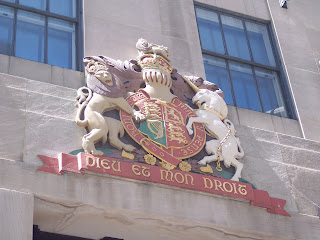
In retirement, one has more time to stare--stare at just about anything. And so, as I waited for my wife outside of a shoe store in Rockefeller Center, I looked up at a building I had known all my life, passed by many times, and never given much thought to. It was the door that caught my attention at first. It took me a while to figure out what was going on. Ultimately, I got the idea. What I was looking at was the "British Empire Building," constructed in 1932, the year the complex of buildings went up.


What most caught my attention was the series of bas-reliefs, awash in gold leaf, situated over the door and just below the crest of the Empire. Based on the nature of the art work, the building was devoted to trade and therefore immortalized--in personified form--the commodities that had helped to create the large fortunes for the empire. Depicted were salt, wheat, wool, coal, fish, cotton and tobacco--the essential products upon which a people's very survival depend.


Now, as I say, I have more time on my hands nowadays. Born in Brooklyn, I have spent over fifty years making excursions into "the city" and exploring its almost infinite wonders--from the glitter of Times Square to the quietude of the reading room at the Public Library. Every district--I could almost say every "block"-- of the city's many districts holds memories for me. They are memories associated with early adolescent excursions, (in the fifties, subway exploration was a safe enterprise for twelve year olds), going out on dates to the big movie houses or Broadway theaters, later, taking my own children in to explore the museums and cultural centers... A real list would be too long.


Each passage in life, however, gives one different "lenses" through which to view one's environment, and, of late, given our nation's tendency to empire, I am impressed by the icons of power that surround us. They have been with us for a long time, now. Many are overhead: the Con Edison beacon, the Chrysler Building's car ornament "griffins," the seemingly endless symbols of a not so secret Masonic "trust" that guides the economies of the Anglo-American Empire--from the murals in the Museum of Natural History to the golden pyramids (echos of our dollar note) that cap so many of the city's nineteenth and early twentieth century skyscrapers.


What jars me into another level of consciousness on this particular day is the special form that these personifcations of such basics as sugar, salt, fish and wool take on the art work atop the entry way to the British Empire Building. I am glad to have taken my camera with me so that I can capture these images and study them at my leisure. Often, I find, my initial reaction is one of shock or amusement. "How do they get away with this?" is a thought that has entered my mind more than once standing in a New York City street. Of course, we are fortunate that there has been no itinerant gang of political correctness police tearing down the politically incorrect art work that we have accumulated over the years, like some post-Soviet squad tearing down the glut of Lenin's statues. Whether we consider a given work art or artifact, the work often has value as history and should be preserved.


Yet, I suspect looking up at these particular doors that the only thing that has saved them is that they have become so part of the landscape that few pause to notice. It is a little bit like so-called white noise--it's there but it is "whited out" in the torrent of other sounds. It is tobacco and cotton that I here find most fascinating. How otherwise account for the fact that these racist images linger over our heads on New York's most prestigious shopping street? It is a bit a like the bare-breasted third world beauties that once (and to some extent still) populate the pages of the National Geographic. These girls are not just bare-breasted. This is not about that, that is, it is not just about art. They are slave girls. And then I think, am I being too sensitive here? Perhaps this door honors the women who once--in chains--harvested the cotton and tobacco of the Anglo-American empire.

Thursday, March 29, 2007

Games Fever TV: FCC Enabled Theft?


If ever there was a single perfect example of the kind of whorehouse capitalism that has proliferated on television since the onset of the Reaganite counter-revolution against regulation and consumer protection, it is the Games Fever TV phenomenon. Stupid People are lured into tolling up charges on their cell phones by text messaging answers to apparently simple word games in exchange for cash prizes. These shows are duplicitous on every level, but what is most appalling about their existence is that under the pretense of being entertainment, they are painfully repetitive, whining entreaties to the viewers to call in. As is the case with many other such "shows," they actually have the nerve to interrupt with commercial breaks--in effect setting up nesting ways to separate the uneducated from their money. I thought that television had gotten about as low as it could get, but given permission by those who are supposed to be the gatekeepers for decency and against exploitative use of a public trust, the spiral continues to descend. Only the truly scatological and the pornographic await our viewing pleasure.

Thursday, March 01, 2007

Kucinich May Be Our Only Hope

Only one Democratic Presidential candidate has spoken out unequivocally on the war in Iraq and therefore warrants the support of all those opposed to the war--Ohio Representative Dennis Kucinich. His stand on the war is clear. And he is an attractive candidate as well for the stands he takes on health care and supporting the plight of U.S. workers. The current spin on Kucinich is that he is not a serious candidate. Polls show him way behind Clinton and Obama. Even among those who do not discount his proclaimed policies, who in fact hear in his public statements echoes of their own point of view, there is fear of another McGovern debacle, that is, having a candidate who is politically correct but too far to the left to win a presidential election. I would argue that a buildup in momentum for Kucinich can only advance the cause of those who want to see an end to the war and a change in this country's direction. If nothing else, it would force more mainstream candidates to shift their stated policies more to the left. On the other hand, it is just possible that simply by virtue of its supposed "wackiness," a groundsurge of support for the Kucinich platform would inject some energy into what is already shaping up to be a tired, demoralized campaign by tired, demoralized party regulars.

Thursday, January 04, 2007

The (Former) King is Dead. Long Live the King!

George Will's remark on ABC to the effect that the majesty and grandeur attendant upon the death of a former president was remarkable in an alleged republic should serve to remind us all--that is, all of us commoners--of who it is that leads this nation. FDR was the last true patrician to serve in the White House. As thanks for having saved the republic, he was seen by his fellow aristocrats as a traitor to his class, as a "Rosenfeld" in WASP attire. He was followed by a haberdasher from Missouri, a talented boy from Abilene, and the Catholic son of a rum runner. Then came Nixon, Ford, Carter, Reagan, Bush, Clinton and Bush, Jr. Not a true aristocrat in the bunch. No, the WASP aristocrats have retreated to their estates, their clubs, and their board rooms and left the dirty business of democracy to the climbers and strivers who serve them so well. No longer will they dirty their hands with the messy running of the post-modern state. Yet, if the citizenry watched the Gerald Ford Pageant carefully it could get a whiff of the way things were supposed to be: Protestant hymns mingled with martial music, a transplanted Gothic cathedral resplendent in the clear winter air, a whiff of candle smoke mingling with the perfumes and colognes heavy in the inner air of the cathedral. In the United States of America, a boy from a poor background--so humble (I believe this is the polite word) a background that he bore the name not of his natural father but of his stepfather--could rise to become the leader of the empire. And be given a king's farewell. For many days now, we have been lulled by these proceedings from the bloodletting in Iraq, lulled from contemplating the price of empire--past and present. For some, the rewards are so great, the trappings of power so intoxicating, that a few lives lost are a small price to pay. What great cathedral would have been built; what great symphony composed; or philosophical tract written without the patronage that can only be paid for by conquest? No. We are still in love with royalty, with the glitter of mirrored palaces. Our behind the scenes rulers--aghast from our very origins at the prospect of a grey, levelled society--will continue for as long as they can to cherry pick from among their lessers men and women who will serve the empire faithfully, loyally--ideally--men and women who actually believe in the dream.

Saturday, December 30, 2006

The Death of Sadaam Hussein

It is clear that U.S. policy makers in this administration can proceed without fear of opposition from any quarter. The Democratic Party's "victory" in the last election was to have fooled the U.S. electorate into believing that its wishes for an early end to the debacle in Iraq would be heeded. These guys can't backtrack fast enough at this point. What is at stake here, however, may be more significant than Democrats and Republicans alike realize. If voting for the so-called opposition party does not bring about a change in direction, voters are left with essentially two options: (a) join the ever-increasing mass of citizens who show little faith in the democratic system and refuse to use the ballot box; or (b) create additional political parties. Perhaps we should all hope for option B. That would mean that at least one good thing will come of the arrogant disregard for the people's will currently being demonstrated by both parties. The assassination of Sadaam Hussein has evocations of Tolstoy's "Hadji Murat" or of the decision to have Marat assassinated by Charlotte Corday. This is the politics of nineteenth century intrigue--a tradition that owes more to Machiavelli than it does to Tom Paine.

Thursday, December 21, 2006

Before--


After--


A Modest Proposal to CBS News

I have a great idea for the CBS News folks. Buy out the rest of Katie Couric's contract before she embarrasses the station any more than she already has. Then, hire Gwen Ifill away from public television's Nightly News. Gwen is an actual journalist as opposed to an entertainer/media personality. She is more than capable enough to do the job and is far more in the tradition of Edward R. Murrow or Dan Rather. She started out as a bright young journalist, is seasoned in television as a result of her years on PBS and is clearly ambitious. Frankly, I find her smiling engagingly at clearly inappropriate times troublesome, but that shouldn't be an issue on network television, and she might even be coached out of some idiosyncrasies she should have abandoned years ago. CBS would win ratings, curiosity seeking viewers, the reputation of being ahead of its time for "discovering" a talented newsperson who happens to be both female and black.

Wednesday, December 13, 2006

Representative Dennis Kucinich: A Voice in the Wilderness?

It is interesting that many callers to C-Span talk-in shows preface their remarks with, "Thank you for C-Span." As a latecomer to the joys of C-Span, I have only recently learned why that is. It is on C-Span alone that one can access a range of opinion rarely encountered on what the left calls the "corporate media." Sadly, that characterization more and more fits the programming on PBS which, since the Gingrich revolution, shifted its political spectrum severely to the right. Even the Nightly News Hour and the now occasional work of Bill Moyers can no longer be depended upon to represent the true diversity of the political spectrum in this country. And thus we are down to Amy Goodman's Democracy Now and the overall broadcasting efforts of Pacifica radio stations such as WBAI here in New York. It is only on C-Span that one could hear the full remarks made by Representative Dennis Kucinich as he announced his candidacy for President on an anti-war platform.

Rep. Kucinich can be seen as a voice in the wilderness. He has already been caricatured as a quixotic figure. And, indeed, while citizens of the U.S. can take pride in the fact that a Dennis Kucinich is still possible, it is alarming that his is one of the very few voices among the Democrats who has called for an immediate withdrawal of troops from Iraq. Kucinich alludes to the estimated 650,000 Iraqis who have died as a result of the U.S.'s illegal invasion and occupation of their nation. Millions more have been injured or forced to flee their homeland. Six hundred and fifty thousand people. Imagine over 200 World Trade Center attacks on our own land. The argument that we must avoid leaving in defeat, that such a departure would not only be a humiliating defeat for this country but disruptive to conditions in the area, an argument which like all big lies, is repeated endlessly, brings political disingenuity to new depths.

The facts is that we have already been humiliated, that the longer we stay, the deeper our humiliation will become, that our only hope for restoring the world's confidence in the people of the U.S. is to demonstrate that we can acknowledge a grave political mistake and begin to make reparations. As for disrupting the area, it is the presence of U.S. troops that is disrupting the area. There is every likelihood that their complete withdrawal--"temporary" bases and all--will bring greater calm to the area.

If the Democrats waffle, temporize, stall on this one, they will be inviting their demise as a U.S. political institution. As of now, it appears that they do not get it. They have a very brief window in which to save themselves.

Friday, December 01, 2006

Manifest Destiny?

After stealing the richer, northern half of Mexico in the name of a (divinely inspired?) destiny that was manifest from our nation's origins and then spending the next 150 years smugly confident that Mexico would no longer be a threat, events seem to be getting out of hand. With Venezuela, Chile and others of our neighbors to the south turning to populist left wing leaders, the very real possibility of a Cuba-like regime south of the Rio Grande is giving U.S. policy
makers pause. Oaxaca is in flames and the floor of the Mexican congress is looking more and more like a rumble. It appears that U.S. immigration policy, namely turning a blind eye to illegal immigrants from Mexico, designed to relieve some of the pressure--and divert some of the votes--may not be enough to stem the tide of radical change.

Tuesday, November 28, 2006

Civil War in Iraq: The Goal of U.S. Policy?

The Bush administration's refusal to characterize the situation in Iraq as a civil war is understandable since it would then have to acknowledge a civil war as the net result of its invasion. The real question is whether or not this was an unforeseen by-product of our policy or, in fact, the goal all along. No one who had not drunk from the poisoned well of the Bush propaganda ministries could ever have found our stated rationale of "democracy building" anything but at odds with reality. It appears that the Iraqi operation can be counted as an enormous success. It has destabilized Iraq for the foreseeable future and has created the conditions for instability--if not expanded military operations--from Lebanon to Afghanistan. No U.S. president could put the lives of our men and women in harm's way with a policy that announced in advance that it had chaos and destruction as its goals.

Monday, November 27, 2006

Eyes on the Prize II

Reaction to illegal immigrants in receiving communities is in many ways, if not most, akin to that evinced by the migration in the post World War II years of African Americans from the South and, here in the Northeast, Puerto Ricans from the Commonwealth. These were internal migrations of people with the full rights (at least on paper) of citizenship. Both Black Americans and Puerto Ricans had the right to live wherever they wished. The story of what happened to hundreds of American cities in the North as a result of those migrations has yet to be told in full. “Block busting”, “white flight”, urban insurrections, riots, the era of “Burn, baby, burn!” have left a legacy that includes vistas of the South Bronx and East New York in Brooklyn resembling firebombed Dresden. Things are seemingly a lot calmer now. The era of the Black Panthers is over. There is no Bobby Seale or Stokely Carmichael or Malcom X to stir up discontent, no call to arms except in the lyrics of rap singers who, if they become violent, seem only to turn on one another. The objective conditions of many Black Americans have improved dramatically. Black Americans and the Latinos (mostly Puerto Ricans) who grew up alongside them are certainly not as invisible as they were in the pre-Civil Rights era that writers like Ralph Ellison and Piri Thomas describe in their writing. Few Black or Latino children would recognize the U.S. cultural landscape of the era before the Civil Rights movement. They would immediately sense the absence of Black and Latino newscasters, television personalities, and politicians; they would sense that there were far fewer sports figures and entertainers in the public eye; but they would also sense the absence in their everyday life of Blacks and Latinos in all the myriad jobs—in banks, in offices, in shops, delivering the mail, putting out fires or walking a neighborhood beat—whose presence we now take for granted but who are in fact present only as the result of a long struggle. Yes, for these reasons and many more, things are a lot calmer now. But the rioting that took place in Los Angeles as recently as the 1990s is a reminder that we are never far from a rekindling of the violence that was for a period of time so common in this country. Things are a lot calmer now. This in spite of the fact that U.S. citizens who happen to be black or brown suffer high unemployment, poor schools, inferior housing, a culture of violence, an illegitimate birth rate of 75% and far less aggregate wealth. Large cities broadcast news stories from their Black and Latino communities every night, stories out of housing projects and poor neighborhoods, stories chronicling the bleak symptoms of an unfinished revolution in the “post”-Civil War, post-Civil Rights Era America.